
Brain fog is common in perimenopause. You may forget words or names, lose your train of thought, or find it hard to focus. The Menopause Society says 40% to 60% of midlife women report memory and thinking symptoms during the menopause transition. It says the changes are typically mild and within the limits of normal, and that dementia at midlife is very rare.
Wondering whether your symptoms fit perimenopause? Our free perimenopause quiz takes about five minutes.
In short
- Brain fog often improves after menopause, says the Office on Women's Health (OWH).
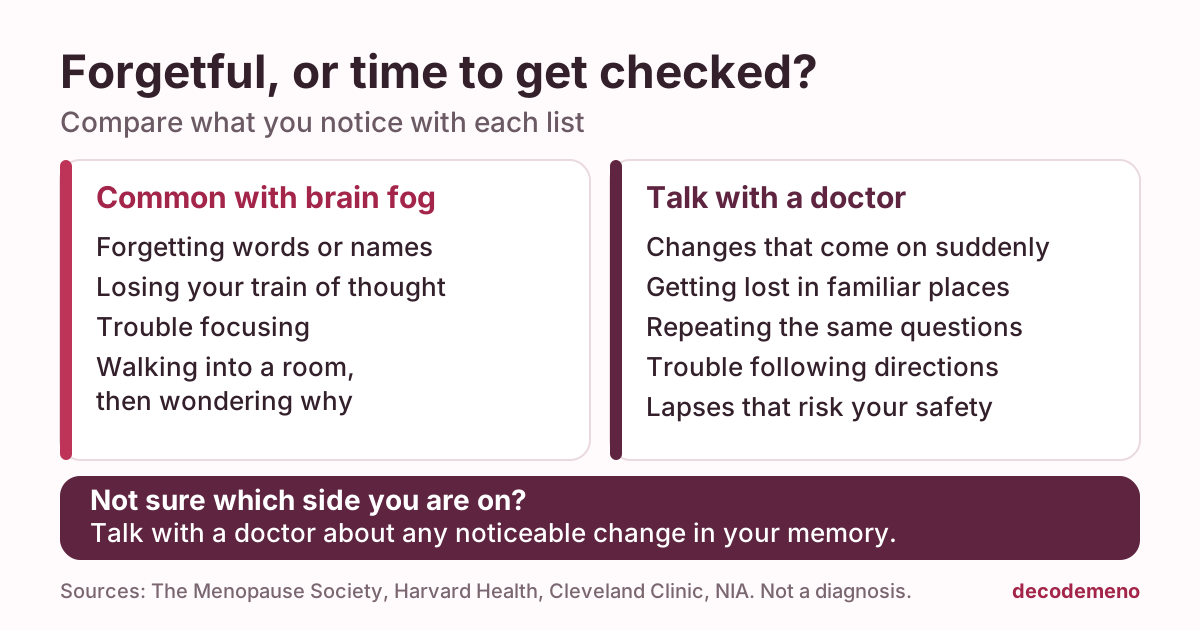
- Dementia at midlife is very rare, says The Menopause Society. The National Institute on Aging (NIA) says to talk with a doctor about any noticeable change in your memory.
- Other problems can cause memory trouble, such as thyroid problems, low vitamin B12, depression and sleep problems, says the National Institute on Aging.
- See a doctor if memory changes come on suddenly, or if lapses could put your safety at risk, says Harvard Health.
See our complete guide to perimenopause symptoms.
What menopause brain fog feels like, and does it go away?
- trouble remembering words, names, stories and numbers (The Menopause Society)
- losing your train of thought (Cleveland Clinic)
- trouble focusing, or being easily distracted (The Menopause Society)
- walking into a room and wondering why (Harvard Health)
OWH says brain fog and memory changes often improve after menopause. In a study that followed 2,362 women for 4 years, women in perimenopause did not improve on repeated memory and speed tests as before. They improved again after menopause. The authors call this subtle: a lack of improvement rather than an obvious decline. They say it suggests the problems may be time-limited.
What can get in the way of focus and memory
- Hormones. Researchers don't know exactly why brain fog happens, because many things change along with the drop in estrogen (Harvard Health). Low estrogen can cause bouts of temporary brain fog that tend to affect memory for words and names (Cleveland Clinic).
- Poor sleep. Lack of sleep might make you more forgetful than normal (NIA). Night sweats and mood changes can disrupt sleep (OWH). See our guide to perimenopause sleep problems.
- Stress. It can interfere with concentration and memory (Harvard Health).
- Low mood and anxiety. Depression and anxiety may cause memory problems (NIA). Mood swings and anger have their own guide: perimenopause rage and mood swings.
Forgetful, or time to get checked?
NIA's page on memory and aging says it's normal to forget things once in a while at any age. Its everyday examples include sometimes forgetting which word to use and losing things from time to time. It also lists signs that it might be time to talk with a doctor.
- asking the same questions over and over
- getting lost in places you used to know well
- having trouble following recipes or directions
- becoming more confused about time, people and places
- not taking care of yourself, such as not bathing or behaving unsafely
What about dementia? Dementia includes losing thinking and memory skills to the point that daily life is affected (NIA). Brain fog can cause distress and anxiety, often from a worry that it is an early sign of dementia, but dementia at midlife is very rare (The Menopause Society). A neurologist (brain specialist) quoted by Cleveland Clinic says menopause-related brain fog tends to stay stable or improve, while dementia tends to progress.
Brain fog, or something else?
This table is a starting point for a talk with your doctor, not a test. The American Thyroid Association says other problems can cause the same symptoms as an underactive thyroid, and only a blood test can tell for sure.
| Possible other cause | What it can look like | What a doctor may check |
|---|---|---|
| Underactive thyroid (too little thyroid hormone) | Feeling cold, tired or down, forgetting things easily | Thyroid blood tests |
| Low vitamin B12 | Trouble remembering things, getting confused easily, numb or tingling hands and feet | Blood tests |
| Low iron (anemia), too few red blood cells | Trouble concentrating or thinking, tiredness, headaches. Heavy periods can cause iron loss | Blood count, iron levels |
| Depression | Trouble concentrating, remembering or making decisions, with low mood | Questions about your symptoms, plus an exam and lab tests to rule out other causes |
| Sleep apnea, breathing that stops and starts in sleep | Daytime sleepiness that can lead to trouble focusing, gasping | Sleep study |
| Medicines and alcohol | Side effects of some medicines, and alcohol, can affect memory | Your medical history and symptoms |
What may help
Brain fog has no specific treatment, and a provider can help find the cause (Cleveland Clinic). Everyday steps may help.
- Sleep and alcohol. Get enough sleep, generally seven to eight hours a night, and limit alcohol (NIA).
- Activity. Cleveland Clinic lists 30 minutes of physical activity a day among first steps.
- Reminders and focus. Use lists, calendars and notes, and keep keys, phone and glasses in one place (NIA). Slow down and do one thing at a time (Harvard Health).
If hot flashes or night sweats bother you, ask your doctor about options (OWH).
Want to see how your symptoms add up? Our free 5-minute quiz uses your age, your cycle and 21 common symptoms, scored on the Greene Climacteric Scale. It gives you an estimate of your phase, not a diagnosis. You see your result before we ask for your email, and you can skip that step. A detailed personal report is available for a fee if you want one. Take the free perimenopause quiz
When to see a doctor
Call your doctor if any of these apply.
- brain fog gets in the way of daily life, for example if you often forget appointments or can't finish ordinary tasks (Cleveland Clinic)
- memory changes come on suddenly, or come with hallucinations, paranoia or delusions (Harvard Health)
- lapses could put your safety at risk, such as affecting your driving or forgetting food on the stove (Harvard Health)
- you notice any of NIA's signs above
- memory problems last more than a few weeks, or you feel depressed for weeks at a time (NIA)
Call 911 right away if you think someone is having a stroke. Signs often come on quickly. They include sudden confusion, trouble speaking or understanding speech, weakness or numbness on one side, trouble seeing or walking, or a sudden severe headache (MedlinePlus). If you are thinking about harming yourself, in the US, call or text 988.
Before your visit, note how long it has lasted and whether it came on suddenly or slowly (MedlinePlus). Bring what OWH lists: your symptoms and how much they bother you, your health history, any hormone therapy you have used, and how long it has been since your last period. Ask whether a thyroid, vitamin B12 or iron problem, or a medicine you take, could play a part.
Frequently asked questions
Is it perimenopause brain fog or early dementia? Brain fog is common in perimenopause, and The Menopause Society says dementia at midlife is very rare. A neurologist quoted by Cleveland Clinic says menopause-related brain fog tends to stay stable or improve, while dementia tends to progress. See a doctor if, for example, you ask the same questions over and over or get lost in places you know well (NIA).
How long does perimenopause brain fog last? OWH says it often improves after menopause. Cleveland Clinic says brain fog in general has no set timeframe, from days to weeks to months or years.
What is the best treatment for perimenopause brain fog? Cleveland Clinic says there is no specific treatment for brain fog, and that studies are mixed on whether hormone therapy helps memory. OWH says hormone therapy is not used to treat brain fog or memory problems alone, and that researchers do not yet know if it lowers the risk of dementia. A doctor can look for a treatable cause, such as depression (NIA). Ask your doctor about your options.
Sources
- The Menopause Society. Perimenopause. Accessed October 2026.
- Office on Women's Health. Menopause symptoms and relief. Accessed October 2026.
- National Institute on Aging. Memory Problems, Forgetfulness, and Aging; Sleep Problems and Menopause: What Can I Do?. Accessed October 2026.
- MedlinePlus. Memory loss; Iron deficiency anemia; Stroke. Accessed October 2026.
- Cleveland Clinic. Brain Fog; Menopause Memory Loss: Should You Be Worried?; Vitamin B12 Deficiency. Accessed October 2026.
- Harvard Health. Menopause and brain fog: What's the link? 2022. Sleep, stress, or hormones? Brain fog during perimenopause. 2021.
- American Thyroid Association. Adult Hypothyroidism. Accessed October 2026.
- National Heart, Lung, and Blood Institute. Sleep Apnea: Symptoms. Accessed October 2026.
- National Institute of Mental Health. Depression. Accessed October 2026.
- Greendale GA, et al. Effects of the menopause transition and hormone use on cognitive performance in midlife women. Neurology, 2009.
This article is for education. It isn't medical advice and doesn't replace a visit with your doctor. Decodemeno sells a personal perimenopause report. Sources checked October 29, 2026.