
Perimenopause can disturb sleep in several ways. Night sweats, which are hot flashes during sleep, may wake you. Some women also find it hard to fall asleep, wake often or wake long before their usual time. In survey data from the American Academy of Sleep Medicine (AASM), 37% of women ages 45 to 64 reported frequent nighttime waking. Hormone changes, mood and other health problems can play a part.
Not sure your nights fit perimenopause? Our free perimenopause quiz takes about five minutes.
In short
- Night sweats are hot flashes during sleep, and they may wake you. In one study of women in the menopausal transition (also called perimenopause) with mild to moderate hot flashes, hot flashes accounted for about 27% of the time spent awake after first falling asleep, on average.
- Waking often was the most common sleep problem among more than 3,000 women followed through the menopausal transition in a large US study, a 2018 review reports. Sleep apnea (breathing that stops and restarts in your sleep) can bring similar complaints.
- Cognitive behavioral therapy for insomnia (CBT-I) is a 6- to 8-week plan for long-term (chronic) insomnia. The National Heart, Lung, and Blood Institute (NHLBI) says it is meant to help you fall asleep faster and stay asleep longer. Ask your doctor whether it fits you.
- Tell your doctor about trouble sleeping. Also talk to a doctor if someone tells you that you snore or gasp for air in your sleep, or if sweating comes with signs such as chest pain, fever or weight loss.
For the full list of changes at this stage, see our complete guide to perimenopause symptoms.
How common are sleep problems at this stage?
The AASM says sleep problems are common during this stage of life. The chart shows its survey data.
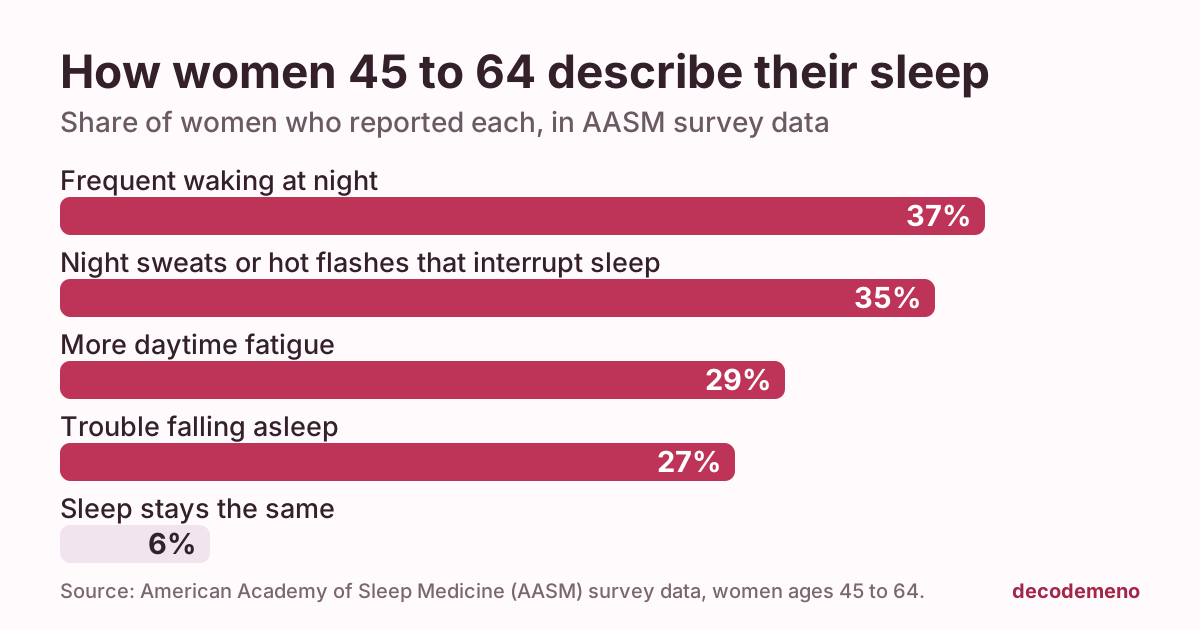
A 2018 review reports sleep difficulties in 40% to 56% of midlife women in the menopausal transition or after it, compared with 31% of women who had not yet reached the transition.
Why sleep breaks in perimenopause
In perimenopause, the ovaries make much less estrogen and progesterone. The National Institute on Aging (NIA) says these hormone changes may explain the symptoms some women notice at this time. The AASM adds that they can contribute to hot flashes, night sweats and mood changes, all of which can interfere with sleep.
The link may run both ways. NIA says research now suggests that waking from sleep may itself trigger hot flashes. It also says a need to urinate might wake you.
Poor sleep can outlast its first cause. NHLBI says worrying about sleep and watching the clock can make insomnia worse. The 2018 review says sleep-related habits may prolong insomnia, whatever started it.
Sleep and mood can feed each other: NIA says lack of sleep can make you feel irritable or depressed. See our guide to perimenopause mood swings.
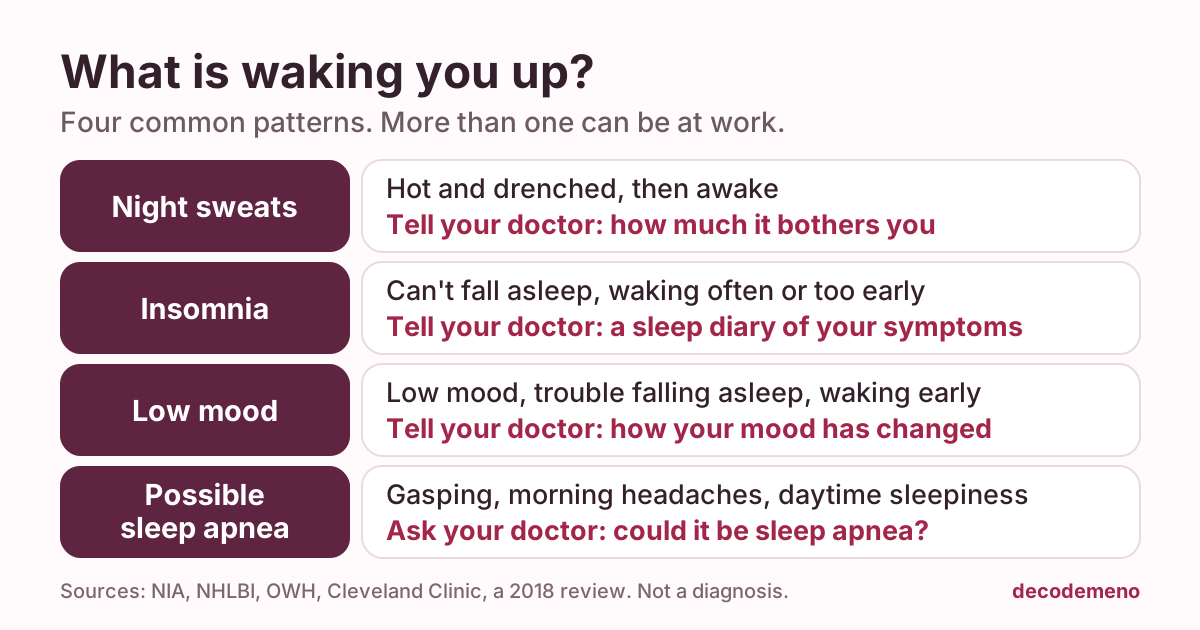
What is waking you up?
Perimenopause is not the only reason for a bad night, and more than one cause is often at work. This table is a starting point for a talk with your doctor, not a test.
| What you notice | What the sources link it to | What to tell your doctor |
|---|---|---|
| You wake hot and drenched in sweat | Night sweats. Hot flashes can also be related to thyroid disorders, other conditions or medicines (Cleveland Clinic) | How much it bothers you. Call your doctor if you often sweat during sleep or the cause is unclear (MedlinePlus) |
| You can't fall asleep, wake often or wake too early | Insomnia: trouble falling asleep, staying asleep or getting good-quality sleep (NHLBI) | A sleep diary: a record of your symptoms (NHLBI) |
| Low mood, with trouble falling asleep or waking earlier than you want | Depression can contribute to poor sleep (NIA). One study of postmenopausal women tied it to trouble falling asleep and waking early | How your mood has changed. NIA says to talk with a primary care provider or mental health professional |
| Waking often, gasping, morning headaches or daytime sleepiness, with or without snoring | Sleep apnea. NHLBI says the risk rises during and after menopause | Ask about sleep apnea. A provider may have you do a sleep study (NHLBI) |
NHLBI says women may not snore, so they may not think they have sleep apnea. It also notes that women may gain weight during menopause, including around the neck. See our guide to weight gain in perimenopause.
What helps, according to the sources
Sleep habits NIA suggests. The list includes a regular sleep schedule, a bedtime routine, and a comfortable, quiet bedroom with no TV or other screens. It also suggests avoiding late-day naps, big meals near bedtime and late-day caffeine, and exercising at regular times but not near bedtime. Alcohol won't help: even small amounts make it harder to stay asleep.
Cooling the room is suggested, but the evidence is limited. NIA suggests a cooler bedroom, layered bedding and a fan if hot flashes keep you up. The AASM suggests moisture-wicking bedding to reduce discomfort from night sweats. The Menopause Society's 2023 position statement found no strong evidence that lifestyle changes such as cooling techniques and avoiding triggers improve hot flashes and night sweats.
Hot flashes can last for years. NIA says they can last for many years. It suggests noting what triggers yours and how much they bother you.
CBT-I, a therapy to ask about. NHLBI describes CBT-I as a 6- to 8-week plan led by a doctor, nurse or therapist, in person, by phone or online. NIA says it has been shown to help improve sleep in women with menopausal symptoms, and advises a therapist with experience working with women in the menopausal transition.
Sleep aids come with limits. NIA says prescription sleep medicines may help when used for a short time, but they and over-the-counter sleep aids do not fix insomnia. NHLBI says to talk to your doctor about the benefits and side effects of insomnia medicines.
Treatments a doctor may discuss. The Office on Women's Health (OWH) says treatments approved by the US Food and Drug Administration (FDA) for moderate to severe hot flashes include hormone therapy and nonhormone medicines, and that each has benefits and risks. It also says treating night sweats can help you sleep better. Ask your doctor what fits your health history.
Want to see how your symptoms add up? Our free 5-minute quiz uses your age, your cycle and 21 common symptoms, scored on the Greene Climacteric Scale. It gives you an estimate of your phase, not a diagnosis. You see your result before we ask for your email, and you can skip that step. A detailed personal report is available for a fee if you want one. Take the free perimenopause quiz
When to see a doctor
Talk to your doctor about trouble sleeping (NIA, OWH), and also if:
- Someone tells you that you snore or gasp for air in your sleep (NHLBI).
- You often sweat during sleep, or you sweat a lot, for a long time or for no clear reason (MedlinePlus).
- Sweating comes with chest pain, fever, a rapid or pounding heartbeat, shortness of breath or weight loss (MedlinePlus).
- You are very sleepy during the day. NHLBI says you may want to ask about sleep apnea.
- You are thinking about harming yourself. In the US, call or text 988, the Suicide & Crisis Lifeline (OWH).
Bring to your visit (OWH, NHLBI):
- Your symptoms and how much they bother you
- A sleep diary: a record of your insomnia symptoms
- Your health history, including cancer, blood clots and heart disease
- Any hormone therapy you have used, and how long it has been since your last period
- The over-the-counter products you take now
Frequently asked questions
Why do I wake up at 3 a.m. in perimenopause? No source we found ties waking to a specific hour. NHLBI says waking too early and not getting back to sleep is common with insomnia. NIA says that once you wake, you might have trouble going back to sleep. Night sweats, a need to urinate, mood changes and sleep apnea can all break sleep. NHLBI says watching the clock can make insomnia worse.
Can perimenopause cause insomnia? It can. The American College of Obstetricians and Gynecologists (ACOG) lists insomnia among the symptoms that can occur during perimenopause. In one phone survey of 982 women, 26% of those in perimenopause met a strict definition of insomnia that required symptoms for 6 months. NHLBI uses a shorter rule: it calls insomnia chronic when it happens 3 or more nights a week, lasts more than 3 months and cannot be fully explained by another health problem.
Are hot flashes worse at night? Not always. Cleveland Clinic says hot flashes aren't necessarily worse at night, but they can feel worse when they wake you up drenched in sweat.
Why am I so sleepy during the day? Poor sleep can leave you tired. ACOG says night sweats may wake you up and make you feel tired and sluggish during the day. The AASM adds that disrupted sleep can make it hard to concentrate. See our guide to perimenopause brain fog. For more on tiredness, see our guide to perimenopause fatigue.
Can perimenopause cause restless legs? The National Institute of Neurological Disorders and Stroke (NINDS) does not list menopause as a cause. It describes restless legs syndrome as an irresistible urge to move the legs, worse at night. It is more common in women and most often begins in middle age.
Sources
- National Institute on Aging: Sleep Problems and Menopause: What Can I Do?, Hot Flashes: What Can I Do?, What Is Menopause?. Accessed October 2026.
- Office on Women's Health. Menopause symptoms and relief. Accessed October 2026.
- American College of Obstetricians and Gynecologists. The Menopause Years (patient FAQ). Accessed October 2026.
- National Heart, Lung, and Blood Institute. Insomnia: overview, symptoms, causes, treatment. Accessed October 2026.
- National Heart, Lung, and Blood Institute. Sleep Apnea: overview, symptoms, women. Accessed October 2026.
- National Institute of Neurological Disorders and Stroke. Restless Legs Syndrome. Accessed October 2026.
- MedlinePlus. Sweating. Accessed October 2026.
- Cleveland Clinic. How To Find Relief for Hot Flashes at Night. Accessed October 2026.
- American Academy of Sleep Medicine. Struggling to sleep during menopause? Here's what to know. Accessed October 2026.
- The Menopause Society (then NAMS). The 2023 nonhormone therapy position statement. 2023.
- Baker FC, et al. Sleep problems during the menopausal transition: prevalence, impact, and management challenges. 2018.
This article is for education. It isn't medical advice and doesn't replace a visit with your doctor. Decodemeno sells a personal perimenopause report. Sources checked October 28, 2026.