
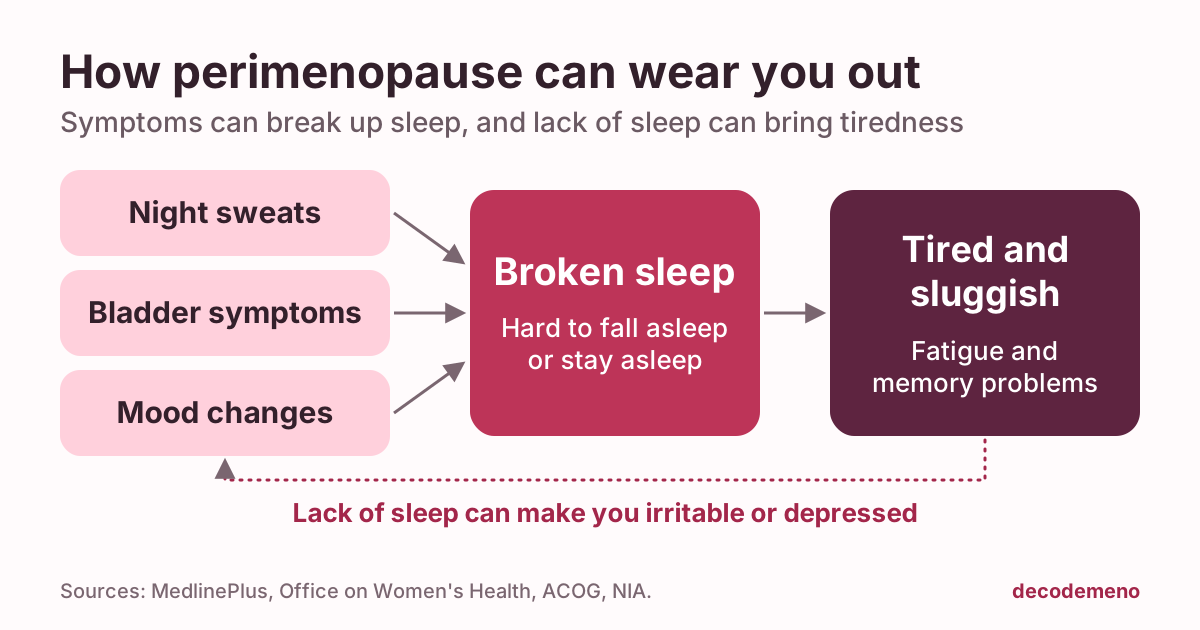
One way perimenopause can leave you exhausted is by breaking up your sleep. Night sweats, bladder symptoms and mood changes can disrupt it, and over time a lack of sleep can lead to fatigue. But low iron, an underactive thyroid, depression and sleep apnea can also cause fatigue. If you have felt tired for weeks, contact your doctor.
Not sure it's perimenopause? Our free perimenopause quiz takes about five minutes.
In short
- Perimenopause can make you tired through poor sleep, but fatigue has many causes. MedlinePlus lists anemia, thyroid disease, depression, anxiety and sleep apnea among them.
- Heavy periods can raise your risk of low iron. Blood loss is a risk factor for iron-deficiency anemia (too few red blood cells because you lack iron), says the National Heart, Lung, and Blood Institute (NHLBI). Periods can get heavier in perimenopause.
- See a doctor if you have felt tired for weeks. Get help right away if tiredness comes with chest pain, shortness of breath or thoughts of harming yourself.
For every change at this stage, see our complete guide to perimenopause symptoms.
Why perimenopause can leave you exhausted
During the menopausal transition (perimenopause), your ovaries start to make less estrogen and progesterone. This can bring night sweats, bladder symptoms and mood changes (MedlinePlus). All three can disrupt your sleep (Office on Women's Health). Night sweats may wake you up. You may then feel tired and sluggish during the day (American College of Obstetricians and Gynecologists, ACOG).
Over time, a lack of sleep can lead to fatigue and memory problems (MedlinePlus). Sleep and mood can affect each other. Mood changes, depression in particular, can add to poor sleep. Lack of sleep can make you feel irritable or depressed (National Institute on Aging, NIA). Our guide to perimenopause sleep problems goes deeper.
The NIA, Cleveland Clinic and Office on Women's Health symptom lists don't name fatigue as a symptom of its own. The NHLBI does say menopause can cause insomnia, headaches and fatigue. You may also see this tiredness called menopause fatigue.
Tired from perimenopause, or something else?
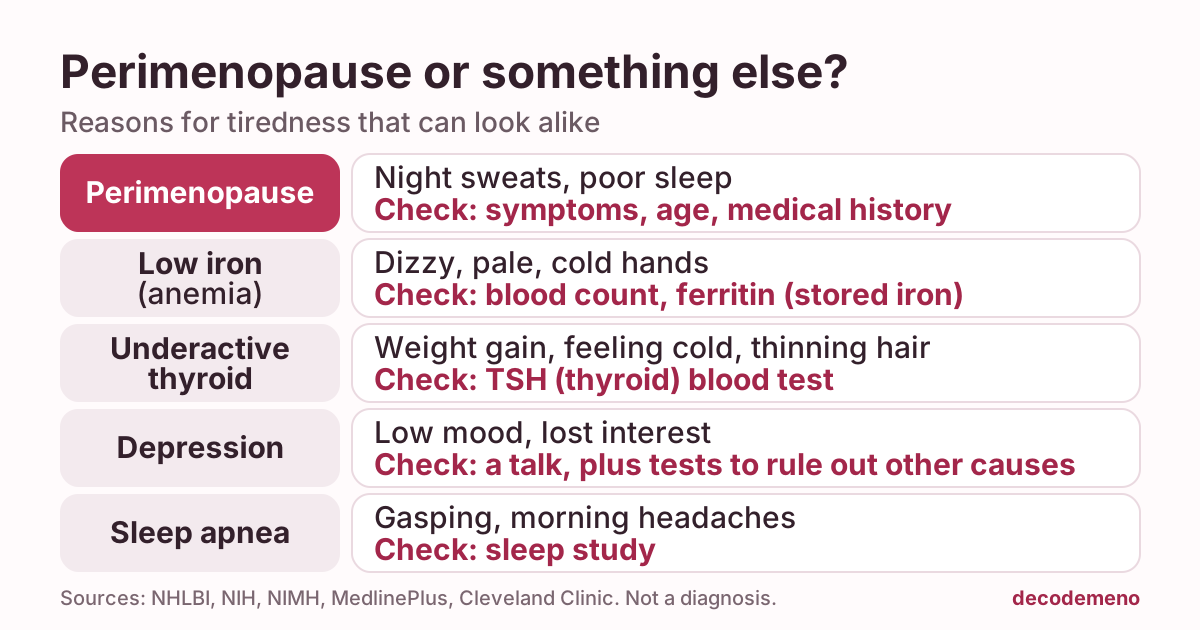
Some perimenopause symptoms look like those of other conditions (Cleveland Clinic).
| Could it be | What it can look like | What a doctor may check |
|---|---|---|
| Perimenopause | Night sweats, poor sleep, mood changes | Symptoms, age, medical history |
| Low iron (anemia) | Tiredness, dizziness, pale skin, cold hands and feet. Heavy periods can raise the risk | Blood count, ferritin (stored iron) |
| Underactive thyroid | Fatigue, weight gain, feeling cold, joint pain, thinning hair, heavy or irregular periods | TSH (thyroid) blood test |
| Depression | Low mood or loss of interest, with fatigue and sleep changes | A talk with your doctor, an exam and lab tests to rule out other causes |
| Sleep apnea | Breathing that stops and starts in sleep, gasping, daytime sleepiness, morning headaches | Sleep study |
- Iron. Your flow can get heavier in perimenopause (ACOG), and heavy periods raise your risk of iron-deficiency anemia (NHLBI). Mild or moderate iron-deficiency anemia may cause no symptoms.
- Thyroid. Fatigue and weight gain are common and don't necessarily mean a thyroid problem (NIH). Symptoms alone can't confirm a thyroid problem. Joint and muscle pain appears on both the perimenopause and thyroid lists (see our guide to perimenopause joint pain).
- Depression. Perimenopausal depression affects some women (National Institute of Mental Health). Major depression includes a low mood or loss of interest, most of the time for at least 2 weeks, that gets in the way of daily activities.
- Sleep apnea. A woman's risk goes up during and after menopause (NHLBI). Women more often have tiredness, insomnia and morning headaches, and may not snore. Because menopause can cause insomnia, headaches and fatigue too, apnea may be harder to spot.
- Other causes. You can still get pregnant in perimenopause, and a provider may order a pregnancy test. Vitamin deficiencies, such as low vitamin D or B12, are often responsible for fatigue (Cleveland Clinic).
Tests a doctor may suggest
A provider will ask about your lifestyle and medicines and do a physical exam. They may also order blood and urine tests (Cleveland Clinic). Tests that may come up:
| Test | What it checks |
|---|---|
| Complete blood count (CBC) | Your blood cells and hemoglobin, an iron-rich protein. Abnormal levels can be a sign of anemia or too little iron, among other things |
| Ferritin | The iron stored in your body. A low level may mean iron-deficiency anemia. Too much iron can also cause weakness or fatigue |
| TSH (thyroid-stimulating hormone) | A level that is too high or too low may be a sign of a thyroid problem |
Tests of the hormones that run your cycle can't reliably confirm perimenopause. Levels rise and fall so much that results can mislead (Cleveland Clinic). A blood count or ferritin result outside the normal range doesn't always mean a condition that needs treatment (MedlinePlus).
What can help
What helps depends on the cause. If broken sleep is behind it, these steps may help. Ask your doctor which fit you.
- Sleep habits. The NIA suggests a regular sleep schedule, keeping TV and devices out of the bedroom, a quiet room at a comfortable temperature and no caffeine late in the day. Even small amounts of alcohol make it harder to stay asleep.
- Regular activity. Regular exercise has been shown to improve energy, mood swings and sleep problems (Cleveland Clinic).
- Treating night sweats. This can help you sleep better. Night sweats are hot flashes during sleep. A doctor may discuss FDA-approved options for moderate to severe hot flashes, including hormone therapy and nonhormone medicines. Each has benefits and risks (Office on Women's Health).
- Therapy for sleep. Cognitive behavioral therapy for insomnia, a problem-solving type of talk therapy, has been shown to help improve sleep in women with menopausal symptoms (NIA).
None of the sources we used recommends a supplement for tiredness itself. If a test finds a cause such as low iron, your provider can usually treat it or help you manage it (Cleveland Clinic). Only a few herbal products used for menopause symptoms have been studied for safety and effectiveness (ACOG). Tell your doctor if you take one.
Want to see how your symptoms add up? Our free 5-minute quiz uses your age, your cycle and 21 common symptoms, scored on the Greene Climacteric Scale. It gives you an estimate of your phase, not a diagnosis. You see your result before we ask for your email, and you can skip that step. A detailed personal report is available for a fee if you want one. Take the free perimenopause quiz
When to see a doctor
Contact your provider if you have felt tired for weeks (MedlinePlus). Cleveland Clinic says to call sooner if your tiredness:
- lasts longer than a few days
- makes daily activities hard
- comes on suddenly
- has no clear reason, or comes with weight loss
See your doctor about heavy bleeding, bleeding after sex or between periods, or bleeding again after a year with no period (NIA). Vaginal bleeding after 12 months with no period is not normal. See your provider right away (Office on Women's Health).
Get medical help right away if tiredness comes with any of these (Cleveland Clinic):
- shortness of breath, or pain in your chest, arm or upper back
- an unusually fast, slow, pounding, fluttering or irregular heartbeat
- headache or vision problems
- nausea, vomiting or belly pain
- muscle weakness
- thoughts of harming yourself or others
If you are thinking about harming yourself, in the US, call or text 988. In a life-threatening situation, call 911.
What to bring to your visit
- Your symptoms and how much they bother you, a diary of when you feel most and least tired (MedlinePlus), your health history, any hormone therapy you have used, and when your last period was.
- A list of your medicines. Some can cause fatigue, such as antidepressants, antihistamines and medicines for nausea and pain (MedlinePlus). If you think a medicine is making you tired, talk to your provider about the risks and benefits of stopping it or trying another (Cleveland Clinic).
- Questions from Cleveland Clinic's list: Are these symptoms of perimenopause? Are there any tests that should be done? Do I need to start taking medication or vitamins? You could add: Could low iron, my thyroid, depression or sleep apnea be part of this?
Frequently asked questions
Is extreme fatigue normal in perimenopause? Broken sleep from night sweats and other symptoms can leave you tired. Extreme tiredness can also have other causes. Talk to your provider if you are tired all the time, or if it makes daily activities hard (Cleveland Clinic).
What helps with perimenopause fatigue? It depends on the cause, so finding the cause comes first. If broken sleep is behind it, steady sleep habits, regular exercise, treating night sweats and cognitive behavioral therapy for insomnia may help.
How long does perimenopause fatigue last? We found no official estimate of how long tiredness itself lasts. Symptoms related to menopause can last between 2 and 8 years, and timing varies a lot (NIA). If it has lasted weeks, get it checked.
Sources
- MedlinePlus. Menopause. Accessed October 2026.
- MedlinePlus. Fatigue. Accessed October 2026.
- MedlinePlus. Complete Blood Count (CBC). Accessed October 2026.
- MedlinePlus. Ferritin Blood Test. Accessed October 2026.
- MedlinePlus. TSH (Thyroid-stimulating hormone) Test. Accessed October 2026.
- National Institute on Aging. What Is Menopause? Accessed October 2026.
- National Institute on Aging. Sleep Problems and Menopause: What Can I Do? Accessed October 2026.
- Office on Women's Health. Menopause symptoms and relief. Accessed October 2026.
- National Heart, Lung, and Blood Institute. Iron-Deficiency Anemia. Accessed October 2026.
- National Heart, Lung, and Blood Institute. Sleep Apnea and Women. Accessed October 2026.
- National Heart, Lung, and Blood Institute. Sleep Apnea: Symptoms. Accessed October 2026.
- National Institutes of Health, NIDDK. Hypothyroidism (Underactive Thyroid). Accessed October 2026.
- National Institute of Mental Health. Depression. Accessed October 2026.
- American College of Obstetricians and Gynecologists. The Menopause Years. Accessed October 2026.
- Cleveland Clinic. Perimenopause. Accessed October 2026.
- Cleveland Clinic. Fatigue. Accessed October 2026.
This article is for education. It isn't medical advice and doesn't replace a visit with your doctor. Decodemeno sells a personal perimenopause report. Sources checked October 28, 2026.