
Joint and muscle aches are a recognized perimenopause symptom. Frozen shoulder is less clear-cut. It most often affects people aged 40 to 60, and women more than men. Hormone changes are thought to contribute, but a causal link to menopause has not been identified.
Not sure where you are in the transition? Our free perimenopause quiz takes about five minutes.
In short
- Joint and muscle aches are a recognized perimenopause symptom. The Office on Women's Health cites them in 57% of women in perimenopause, compared with 40% before.
- The link between menopause and frozen shoulder is a theory. A 2025 British guideline says hormone changes are thought to contribute, but no causal link has been identified.
- Shoulder and joint pain can have other causes. Arthritis and rotator cuff problems (the muscles and tendons that move the shoulder) can cause similar pain.
- Sudden left shoulder pain can sometimes signal a heart attack. Call 911 for sudden pressure or crushing pain in your shoulder, especially with shortness of breath, dizziness or sweating.
More in our guide to perimenopause symptoms.
What is frozen shoulder?
Frozen shoulder is also called adhesive capsulitis. The tissue around the shoulder joint gets thick, stiff and inflamed. The American Academy of Orthopaedic Surgeons (AAOS) says the main signs are severe pain and a shoulder you cannot move, on your own or with someone else's help.
It develops in three stages, which a British guideline says overlap a lot.
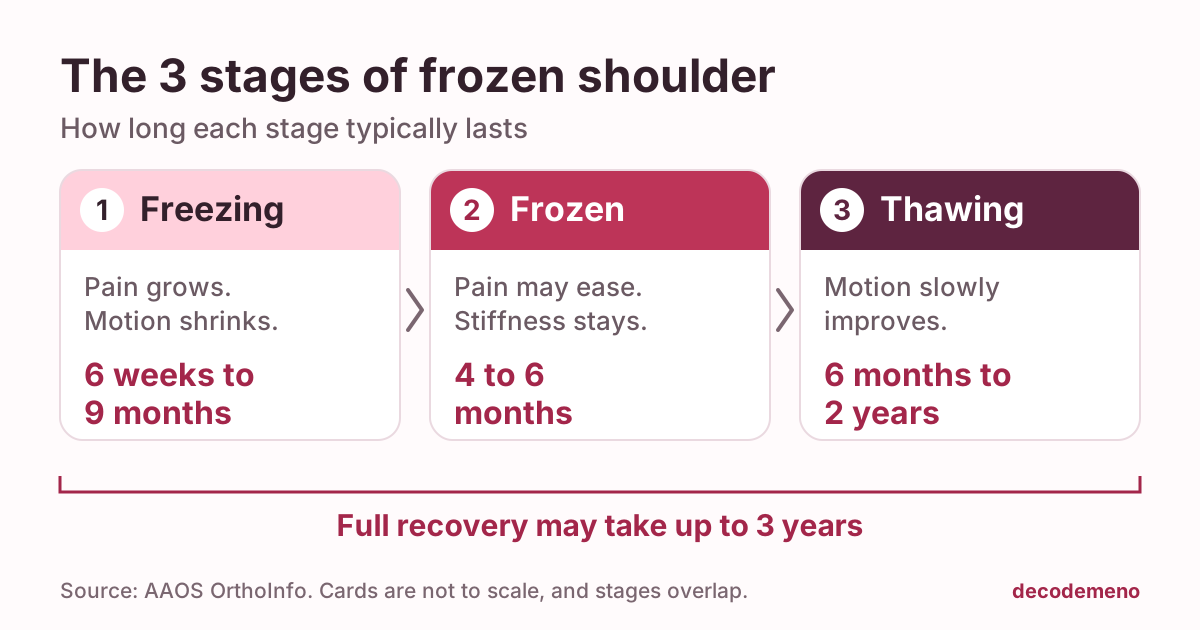
AAOS says the causes are not fully understood. Diabetes and thyroid conditions raise the risk. So can keeping the shoulder still for a while after surgery, a fracture or another injury.
Is frozen shoulder linked to menopause?
Possibly, but it has not been shown.
| Question | What sources show | How sure |
|---|---|---|
| Does it hit midlife women most? | AAOS: ages 40 to 60, women more than men | Well supported |
| Do hormone changes cause it? | British guideline: thought to contribute, no causal link identified. MedlinePlus lists hormone changes, such as menopause, as a risk factor. AAOS does not list it | A theory |
| Is it more common in perimenopause? | Korean study of women with shoulder pain (197 perimenopausal, 113 premenopausal): frozen shoulder was the top diagnosis in both groups (35.4% and 31.8%, no significant difference). Inflamed joint lining (synovitis) was more common in perimenopause: 25.1% vs 6.2% | Not shown for frozen shoulder |
| Do experts see a link? | A 2025 panel of 14 experts, mostly physical therapists: 86% agreed menopause or perimenopause plays a part | Opinion only |
| Does hormone therapy lower the risk? | A 2026 pilot study of 1,952 postmenopausal women aged 40 to 60: frozen shoulder in 7.65% without hormone therapy, 3.95% with it, a gap that may be chance (only 152 were on hormone therapy) | Unknown |
The theory: estrogen helps calm inflammation. So low levels may leave the joint prone to inflammation and thickening. A 2025 narrative review (one researcher's summary of past studies) rates this evidence as moderate. Most of it is indirect or from lab studies. It notes that not every postmenopausal woman gets frozen shoulder, and some premenopausal women do. So low estrogen alone does not seem to be enough.
Joint pain in perimenopause
The Office on Women's Health cites a review of 37 studies: 57% of women in perimenopause had muscle or joint pain, compared with 40% before. A 2020 analysis pooling 16 studies agrees. Pain was more likely in perimenopause than before it. It was about as likely as after menopause. In perimenopause, pain rates ran from 50% to 89%, partly because studies used different questionnaires. The authors call the menopause link possible and want studies that follow women over time.
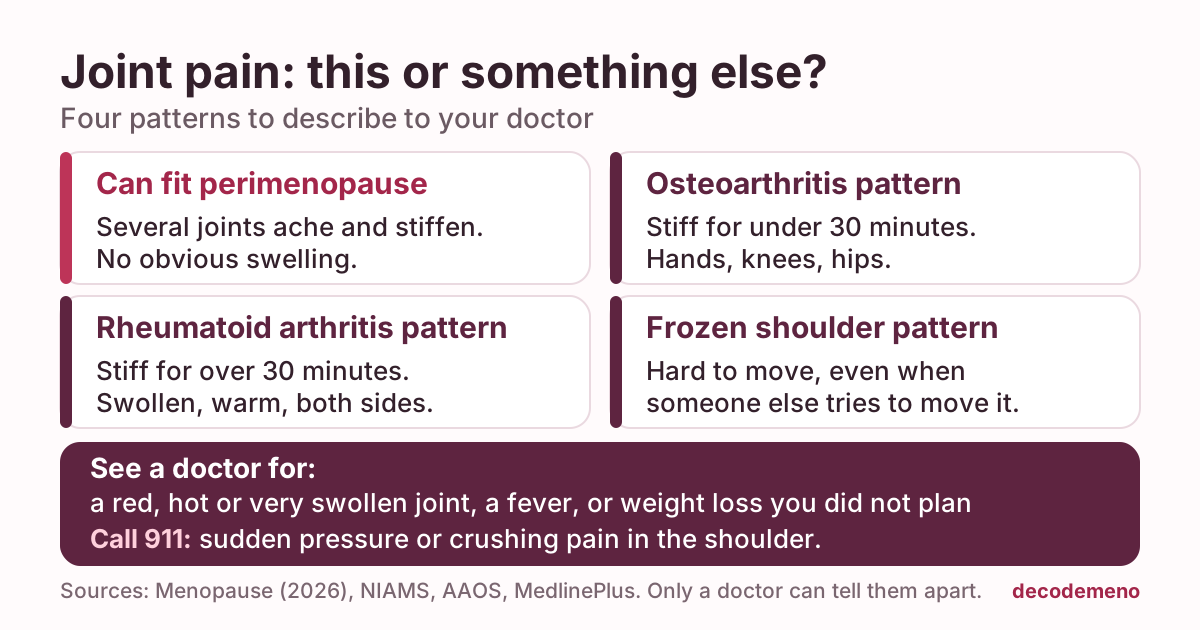
A 2026 article in the journal Menopause says women describe pain and stiffness in several joints, without obvious swelling. This pain does not usually damage the joints, but it can be very disabling. No gold-standard test confirms menopause as the cause.
The National Institute on Aging lists stiff, weak, achy joints and muscles among common midlife changes. It says some may be part of aging rather than menopause. Being overweight may also make osteoarthritis (the most common type of arthritis) more likely, says NIAMS, part of the US National Institutes of Health. See our guide to weight gain in perimenopause.
Perimenopause, arthritis or something else?
At ages 40 to 60, joint pain has many possible causes. The 2026 article lists osteoarthritis, gout and low estrogen as common ones. Less common ones, such as rheumatoid arthritis, need a look too. Thyroid problems, some medicines, overuse injuries and low vitamin D can also cause aches.
| What sources describe | |
|---|---|
| Perimenopause aches | Pain and stiffness in several joints, no obvious swelling, often with hot flashes, mood or sleep changes |
| Osteoarthritis | Stiffness after rest, usually under 30 minutes. Often in the hands, knees or hips. For many women it starts after menopause |
| Rheumatoid arthritis | Stiffness over 30 minutes, with swelling and warmth, often on both sides of the body. May bring tiredness and an occasional low fever |
| Frozen shoulder | A shoulder that will not move well, even when someone else tries to move it. Dull ache over the outer shoulder |
| Rotator cuff problem | Trapped, inflamed tendons are the most common cause of shoulder pain. Pain may come when lifting the arm overhead |
If tiredness is your main complaint, see our guide to perimenopause fatigue.
Want to see how your symptoms add up? Our free 5-minute quiz uses your age, your cycle and 21 common symptoms, scored on the Greene Climacteric Scale. It gives you an estimate of your phase, not a diagnosis. You see your result before we ask for your email, and you can skip that step. A detailed personal report is available for a fee if you want one. Take the free perimenopause quiz
What a doctor may do
For frozen shoulder, AAOS names physical therapy, with a focus on flexibility, as the main treatment. Therapy includes stretching or range-of-motion exercises, with a physical therapist or at home. A doctor may also discuss anti-inflammatory medicines, a cortisone (steroid) injection, or, if those do not help, hydrodilatation, which injects fluid to stretch the joint capsule. If other methods fail, surgery may come up. Ask your doctor what fits you.
For menopause-related aches, the 2026 article says to look for arthritis and other causes first. It advises resistance (strength) exercise and says women new to it may benefit from a physical therapy referral. It adds that hormone therapy may play a role, but no large trials have tested it for joint pain. If you want to ask about it, talk with your doctor about what it could mean for you.
Questions to ask your doctor
- Is this frozen shoulder, arthritis or a rotator cuff problem? Do I need an X-ray or MRI?
- Which stage am I in, and is physical therapy a good start?
- Could diabetes, a thyroid problem or something besides perimenopause explain my aches?
The Office on Women's Health suggests a few things to bring. List your symptoms and how much they bother you. Add your health history, any hormone therapy you have used, and how long it has been since your last period.
When to see a doctor
- Call 911 for sudden pressure or crushing pain in your shoulder, especially if it runs from your chest to your left jaw, arm or neck, or comes with shortness of breath, dizziness or sweating (MedlinePlus).
- See your doctor about a sore shoulder with a fever, swelling, redness, or red or blue skin. Also for significant pain when you or someone else moves it, or pain lasting more than 2 to 4 weeks despite home care (MedlinePlus).
- See your doctor about any joint if pain lasts beyond 3 days, is severe with no clear cause, or comes with a very swollen joint, trouble moving it, red or hot skin, a fever, or weight loss you did not plan (MedlinePlus).
- Tell your doctor about new or worsening pain, or shoulder pain and stiffness that may be frozen shoulder (Office on Women's Health, MedlinePlus).
Frequently asked questions
How long does frozen shoulder last? Full recovery may take up to 3 years, says AAOS. MedlinePlus says an untreated case often improves within 2 years.
Does hormone therapy help frozen shoulder? Nobody knows yet. A 2026 article in Menopause calls for more research. A 2026 pilot study looked only at risk, not treatment: 3.95% of the 152 women on hormone therapy had frozen shoulder, compared with 7.65% of the others, a gap that may be chance. Ask your doctor.
How can I tell perimenopause joint pain from arthritis? NIAMS says osteoarthritis stiffness usually lasts under 30 minutes, often in the hands, knees or hips. Stiffness over 30 minutes, swelling, warmth and symptoms on both sides of the body fit rheumatoid arthritis. Perimenopause aches are described without obvious swelling. A doctor can check.
Sources
- AAOS OrthoInfo. Frozen Shoulder. Accessed October 2026.
- MedlinePlus. Frozen shoulder. Accessed October 2026.
- MedlinePlus. Shoulder pain. Accessed October 2026.
- MedlinePlus. Arthritis. Accessed October 2026.
- Office on Women's Health. Menopause symptoms and relief. Accessed October 2026.
- National Institute on Aging. What Is Menopause? Accessed October 2026.
- NIAMS. Osteoarthritis. Accessed October 2026.
- NIAMS. Rheumatoid Arthritis. Accessed October 2026.
- Rupani N, et al. British Elbow and Shoulder Society patient care pathway: Frozen shoulder. 2025.
- Salamh P, et al. An international consensus on the etiology, risk factors, diagnosis and management for individuals with frozen shoulder: a Delphi study. 2025.
- Navarro-Ledesma S. Frozen shoulder as a systemic immunometabolic disorder: the roles of estrogen, thyroid dysfunction, endothelial health, lifestyle, and clinical implications. 2025.
- Reinke EK, et al. A preliminary pilot study to address design issues related to research on potential association of hormone therapy and adhesive capsulitis. 2026.
- Yoon S, et al. Perimenopausal arthralgia in the shoulder. 2018.
- Manno RL. Joint pain and menopause. 2026.
- Lu CB, et al. Musculoskeletal pain during the menopausal transition: a systematic review and meta-analysis. 2020.
This article is for education. It isn't medical advice and doesn't replace a visit with your doctor. Decodemeno sells a personal perimenopause report. Sources checked October 28, 2026.