
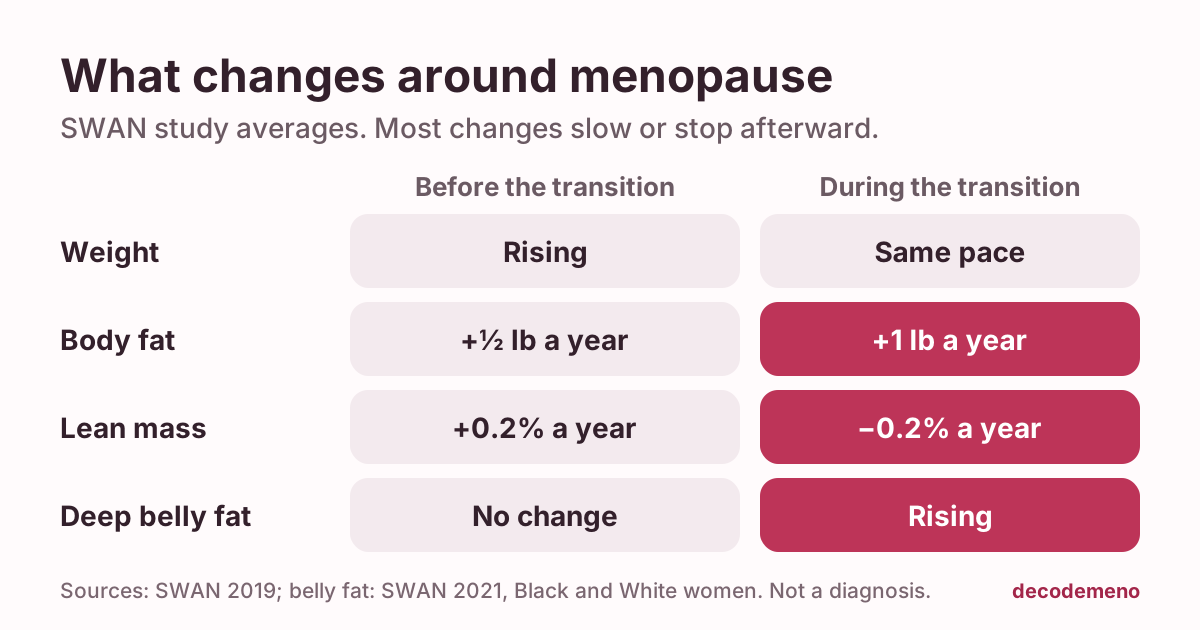
Many women gain weight around menopause. In SWAN, a large US study that follows women through midlife, weight kept rising at the same steady pace through the menopause transition. But from about 2 years before to 2 years after the final period, fat gain nearly doubled on average, lean mass (which includes muscle) fell, and fat shifted toward the middle. Aging and the transition both play a part.
Wondering how your weight fits with your other symptoms? Our free perimenopause quiz takes about five minutes.
In short
- The scale can hide the change. In the SWAN study, weight kept its pace through the transition. Around the final period, fat gain nearly doubled and lean mass fell, on average.
- "Menopause belly" is an informal term, not a medical diagnosis. A large US study (SWAN) linked the transition with more fat in the center of the body.
- Adults need regular activity. The US Department of Health and Human Services (HHS) says adults need at least 150 to 300 minutes of moderate aerobic activity a week, plus muscle-strengthening on at least 2 days.
- Be wary of weight-loss products. The FDA says many products that claim to help with weight loss, such as diet pills, supplements and teas, are likely to be contaminated with dangerous hidden ingredients.
- Some changes call for a doctor. Examples are weight gain with swollen feet and shortness of breath, or bloating on more than 12 days a month.
Weight is one of many possible changes. See our guide to perimenopause symptoms.
What the research shows about weight at menopause
SWAN stands for the Study of Women's Health Across the Nation. The NIH funds it. A 2019 analysis of 1,246 women lined up their weight and body scans with the date of each woman's final period. Here is what happened, on average:
- Weight rose about half a pound (0.25 kg) a year during the transition, the same pace as before. Afterward, it leveled off.
- Fat rose about half a pound (0.25 kg) a year before the transition. From about 2 years before the final period to about 2 years after, the gain nearly doubled to about a pound (0.45 kg) a year. In all, that added up to about 3.5 lb (1.6 kg).
- Lean mass (muscle, water and organs, but not bone) edged up by 0.2% a year before the transition, then fell by 0.2% a year during it.
- Fat and lean mass both leveled off about 2 years after the final period.
Fat rose while lean mass fell, which helps explain why the scale showed no speed-up. The women were Black, Chinese, Japanese or White, and some patterns differed by group.
Aging or the transition?
Both play a part. Cleveland Clinic says age alone can make it harder to keep weight steady, because metabolism slows and muscle mass tends to fall. Yet in SWAN, the faster fat gain and the drop in lean mass were linked to the transition itself.
Why the belly changes
Cleveland Clinic says "menopause belly" isn't a medical diagnosis. It is an informal term for the extra belly fat you may notice as you get closer to menopause. Before menopause, you may be more likely to carry fat on your hips and thighs. As estrogen declines, fat can shift toward your abdomen.
A second SWAN analysis followed 380 women. Overall, the shift from before to after menopause came with more fat in the center of the body and less in the outer parts. In Black and White women, central fat grew nearly 5 times faster during the transition. Deep belly fat (visceral fat) also began to rise. In Japanese women, neither rose during the transition.
The authors call the hormone changes of the transition a plausible reason. But the study did not look at hormone levels, diet or activity. Waist size crept up at every stage, while deep belly fat jumped at the transition. So a tape measure can miss some of this shift.
Cleveland Clinic adds that menopause belly isn't a health problem by itself. But it can lead to visceral fat, which surrounds your organs and makes your belly firm. High levels are linked to a higher risk of heart and blood vessel disease, high blood pressure, high cholesterol and high blood sugar.
What helps, according to US health sources
Stay active. The HHS Physical Activity Guidelines for Americans say adults need moderate aerobic activity, like brisk walking or fast dancing, and muscle-strengthening activity, like lifting weights or doing push-ups. They add that any amount of activity has some health benefits, and that activity reduces the risk of excessive weight gain. Cleveland Clinic says strength training helps maintain and build muscle. It also says core exercises can't reduce belly fat. If joint pain makes activity harder, see our guide to frozen shoulder and joint pain in perimenopause.
Make sleep a priority. Cleveland Clinic says sleep loss can affect the hormones that regulate appetite, and hot flashes and night sweats can keep you awake. See our guide to perimenopause sleep problems.
Eat whole foods. Cleveland Clinic suggests meals built around whole, minimally processed foods, like lean protein and vegetables.
Get help with symptoms. Cleveland Clinic says menopause symptoms can make it harder to focus on eating well and being active, and suggests talking with a healthcare provider about managing those symptoms. If tiredness is one of them, see our guide to perimenopause fatigue.
Be wary of weight-loss products
None of the sources above suggests a supplement or a weight-loss tea for menopause weight gain. The FDA warns about weight-loss products. It says many products that claim to help with weight loss, such as diet pills, supplements and teas, are likely to be contaminated with dangerous hidden ingredients. It says they pose a serious health risk and may not work.
Is it the transition, or something else?
| If you notice | What to know |
|---|---|
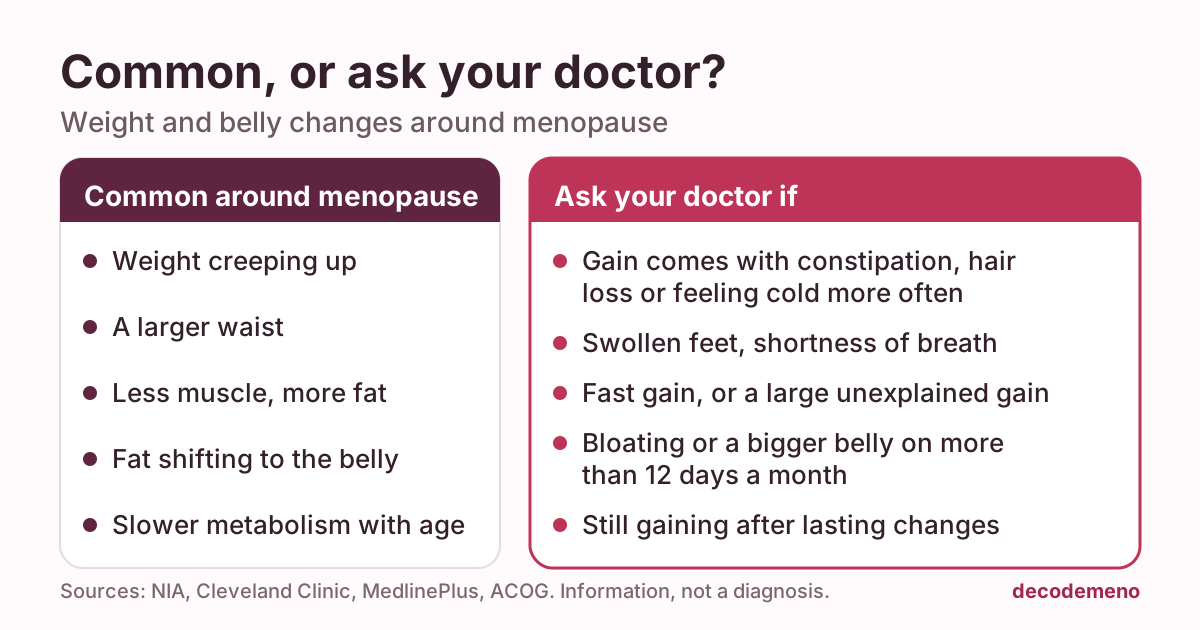
| Weight creeping up, a larger waist, less muscle | The National Institute on Aging (NIA) says these can happen during the transition. Age matters too, says Cleveland Clinic. |
| A gain after starting a medicine | MedlinePlus names birth control pills, corticosteroids (steroid medicines), and some medicines for depression, bipolar disorder, schizophrenia and diabetes. Don't stop one without talking with your provider. |
| A gain with other health problems | Cleveland Clinic lists diabetes, sleep apnea, thyroid problems, depression and PCOS (polycystic ovary syndrome). |
| Swelling or bloating | MedlinePlus says a buildup of fluid can add weight. The American College of Obstetricians and Gynecologists (ACOG) says to contact your ob-gyn about bloating, especially on more than 12 days a month. |
When to see a doctor
Cleveland Clinic says it's worth bringing up with a healthcare provider if you are still gaining weight after lasting changes to how you eat and move. MedlinePlus says to contact your provider if weight gain comes with:
- constipation, hair loss, or feeling cold more often than before
- swollen feet and shortness of breath
- uncontrollable hunger with palpitations (a pounding heartbeat), tremor and sweating
- vision changes
MedlinePlus also lists excessive weight gain with no known cause. It says rapid weight gain may be a sign of dangerous fluid retention.
In its ovarian cancer FAQ, ACOG says to contact your ob-gyn if you have any of these, especially on more than 12 days a month:
- bloating or an increase in abdominal size
- pelvic or abdominal pain
- trouble eating or feeling full quickly
- urinary frequency or urgency
ACOG says these symptoms don't mean you have ovarian cancer, but it's a good idea to find the cause.
Questions to ask your doctor:
- Could a medicine or a condition, like a thyroid problem, be adding to this?
- Which tests, if any, make sense for me?
- How much activity is right for me?
Want to see how your symptoms add up? Our free 5-minute quiz uses your age, your cycle and 21 common symptoms, scored on the Greene Climacteric Scale. It gives you an estimate of your phase, not a diagnosis. You see your result before we ask for your email, and you can skip that step. A detailed personal report is available for a fee if you want one. Take the free perimenopause quiz
Frequently asked questions
Can hormone therapy help with weight gain? Cleveland Clinic says hormone therapy isn't a weight-loss treatment. Whether hormone therapy makes sense for you depends on your symptoms, health history and risks. Ask your doctor.
Is it harder to lose weight in perimenopause? Cleveland Clinic says losing or maintaining weight can be harder during perimenopause, but it is not entirely out of your hands. It says being persistent matters more than quick results.
Is sudden weight gain normal in perimenopause? The average pattern is slow: in the SWAN study, weight rose about half a pound (0.25 kg) a year during the transition. MedlinePlus says a rapid weight gain may be a sign of dangerous fluid retention. Contact your provider if it comes with swollen feet and shortness of breath.
Sources
- American College of Obstetricians and Gynecologists. Ovarian Cancer (patient FAQ). Accessed October 2026.
- Cleveland Clinic. Menopause Weight Gain: Why It Happens and What To Do About It. Accessed October 2026.
- Cleveland Clinic. What Causes "Menopause Belly" and What You Can Do About It. Accessed October 2026.
- Greendale GA, et al. Changes in body composition and weight during the menopause transition (SWAN). JCI Insight, 2019.
- Greendale GA, et al. Changes in regional fat distribution and anthropometric measures across the menopause transition (SWAN). J Clin Endocrinol Metab, 2021.
- MedlinePlus. Weight gain: unintentional. Accessed October 2026.
- National Institute on Aging. What Is Menopause? Accessed October 2026.
- U.S. Department of Health and Human Services, ODPHP. Top 10 Things to Know About the Second Edition of the Physical Activity Guidelines for Americans. Accessed October 2026.
- U.S. Food and Drug Administration. Weight Loss Product Notifications. Accessed October 2026.
This article is for education. It isn't medical advice and doesn't replace a visit with your doctor. Decodemeno sells a personal perimenopause report. Sources checked October 28, 2026.