
Perimenopause can make you more irritable, moody or tearful. People call it "perimenopause rage." The National Institute on Aging (NIA) says scientists don't know why these mood changes happen. Hormones, poor sleep and stress may play a part. The American College of Obstetricians and Gynecologists (ACOG) says about 4 in 10 women have PMS-like mood symptoms in perimenopause. If it wears you down, talk to a doctor.
Want an estimate of your perimenopause phase? Our free perimenopause quiz takes about five minutes. It is not a diagnosis.
In short
- Irritability and mood swings are common in perimenopause. NIA, the Office on Women's Health (OWH) and Cleveland Clinic all list mood changes such as irritability.
- Anger can also be a sign of depression. The National Institute of Mental Health (NIMH) says depression can look like anger or irritability, not only sadness.
- Sleep, movement and stress relief are the everyday measures the sources list. A doctor may also discuss therapy and medicines.
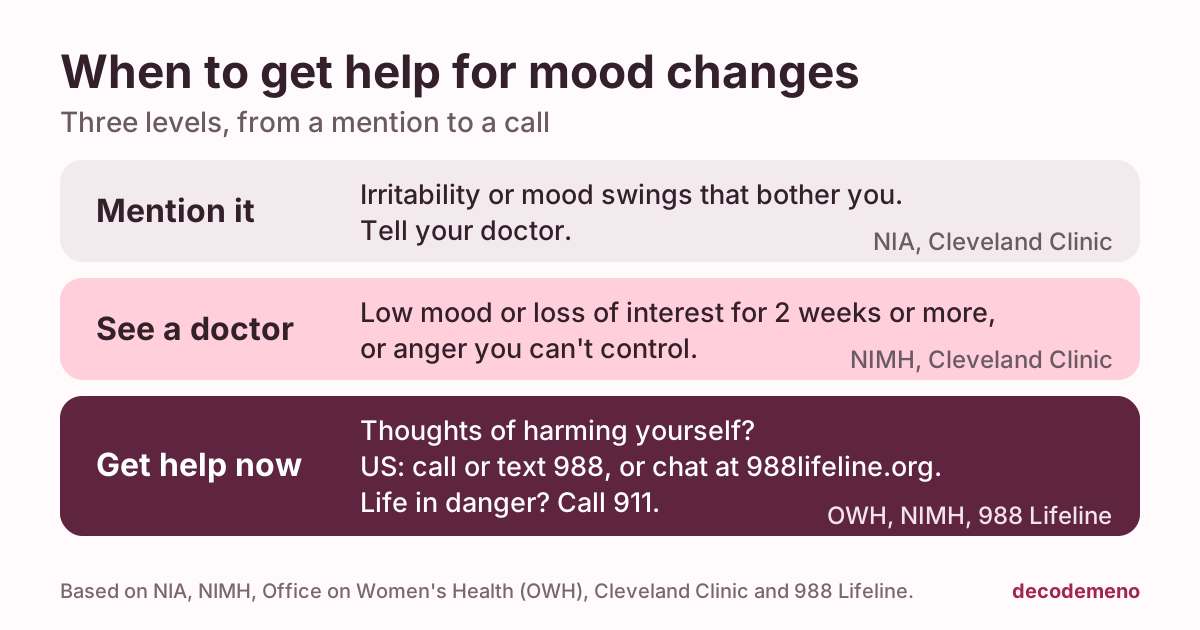
- Low mood or loss of interest for 2 weeks or more is a reason to see a doctor. If you are thinking about harming yourself, in the US, call or text 988, or chat at 988lifeline.org (OWH, NIMH).
For the full list of changes at this stage, see our complete guide to perimenopause symptoms.
What it can feel like
People also say "menopause rage" or "menopausal rage," but none of the medical sources we read use the word "rage." They call it irritability or mood swings. They use "anger" for depression and for PMDD, a more serious form of PMS. OWH lists "irritability or hostile behavior" for PMS itself.
| If you'd say... | The sources say... |
|---|---|
| "I have a short fuse." | You might feel moodier or more irritable (NIA). |
| "I cry over nothing." | You might feel tearful (ACOG). |
| "I'm fine, then I'm not." | Mood swings (Cleveland Clinic). |
| "I don't feel like myself." | "Not feeling like yourself" is on OWH's symptom list. |
| "I'm furious and can't say why." | The sources call this irritability (NIA, OWH). With low mood or loss of interest, it can signal depression (NIMH). |
ACOG says these symptoms may come at times unrelated to your cycle, and may occur for years with no pattern. It also lists trouble concentrating, covered in our guide to perimenopause brain fog.
Why it can happen
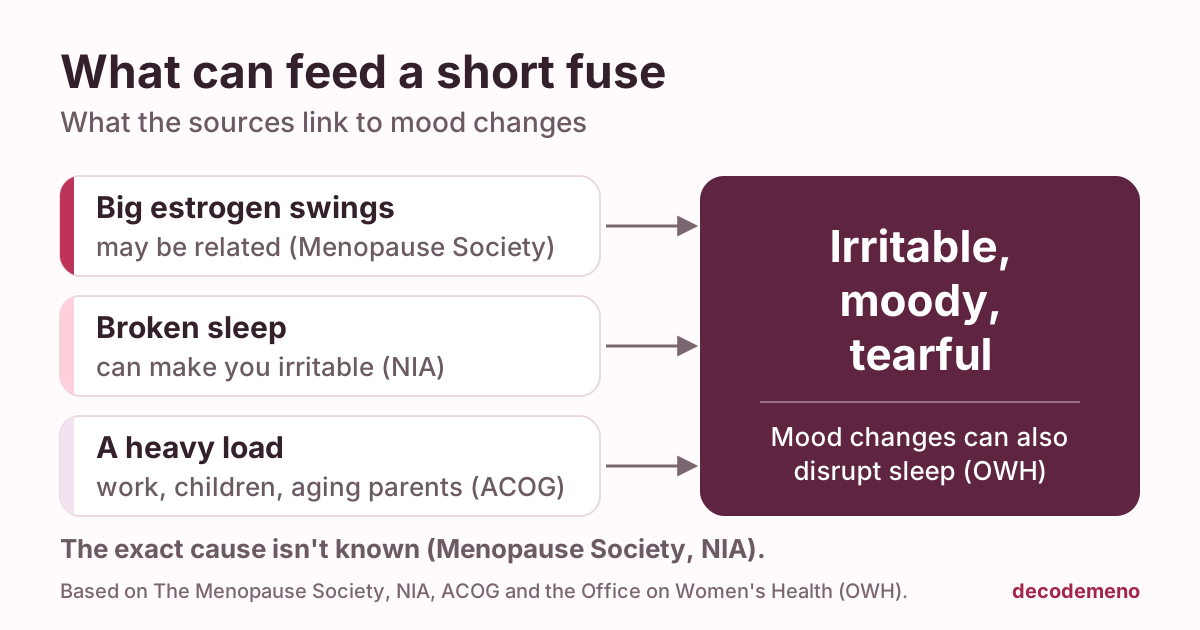
The Menopause Society says big estrogen swings in perimenopause may be related to mood symptoms. It adds that the precise mechanism isn't known. Other factors may play a part, and views differ.
- Broken sleep. Night sweats, bladder symptoms and mood changes can disrupt sleep (OWH). Lack of sleep can make you feel irritable or depressed (NIA), and make it harder to control your emotions and behavior (ACOG). See our guide to perimenopause sleep problems.
- A heavy load. Your 40s and 50s are when life's pressures can be greatest, with demanding jobs, children and aging parents (ACOG).
- A more cautious view. Harvard Health Publishing says hormone changes are unlikely to make women chronically irritable, though the unpredictability of perimenopause can provoke some episodes.
Who may be more likely to have it
- A history of depression. The best predictors of mood symptoms at midlife are life stress, poor overall health and a history of depression (Harvard Health Publishing). Women at greatest risk of depression in perimenopause have a history of depressed mood (The Menopause Society).
- Moods that react to your cycle. PMS may get worse as you approach menopause, especially if your mood is sensitive to hormone changes during your cycle (OWH).
Mood swings, depression or something else?
Some perimenopause symptoms look like other conditions (Cleveland Clinic). This table is a starting point for a talk with your doctor, not a test.
| It could be | Clues from the sources |
|---|---|
| PMS or PMDD | PMS is likely if symptoms come in the 5 days before your period for at least 3 cycles in a row, end within 4 days after it starts, and keep you from some normal activities (OWH). PMDD can bring extreme irritability in the week or two before your period. Symptoms improve within a few days after your period starts. For some people, PMDD symptoms last until menopause (Cleveland Clinic). |
| Depression | Low mood or loss of interest most of the day, nearly every day, for at least 2 weeks. Crying a lot, feeling hopeless, worthless or numb. It can show as anger or irritability instead of sadness (NIMH, ACOG). |
| Overactive thyroid | Symptoms can include nervousness, irritability, trouble sleeping, fatigue, sweating and a rapid or irregular heartbeat. A blood test might confirm it (NIDDK). |
Most studies agree that the risk of depression goes up in the menopause transition (ACOG). Some medicines and conditions, such as thyroid disorders, can cause the same symptoms as depression (NIMH). A provider can rule them out.
What helps, according to the sources
Ask your doctor what fits you.
- Protect your sleep. ACOG suggests a steady bed and wake time, no screens in the hour before bed, and a quiet, cool, dark bedroom. Treating night sweats can help you sleep better (OWH).
- Move. Regular exercise has been shown to improve energy, mood swings and sleep problems (Cleveland Clinic).
- Lower the stress load. Anything that reduces stress can help, such as meditation, yoga, playing music, journal writing or massage therapy (ACOG). NIMH suggests talking to people you trust about how you feel.
The FDA has not approved any natural products for depression, and some can interact with prescription medicines. Talk to a health care provider before using one (NIMH).
Options a doctor may discuss
Talk to a health care provider before starting or stopping any medication (NIMH).
- Talk therapy. Cognitive behavioral therapy (CBT) teaches you to challenge and change unhelpful thoughts and behaviors (NIMH). CBT and mindfulness-based stress reduction may help with depression and anxiety during perimenopause (OWH).
- Antidepressant medicines. They can help with depressive and anxious symptoms (ACOG).
- Hormone therapy. Medicines that provide estrogen may help with depression during perimenopause (ACOG). Hormone therapy alone isn't effective for more severe mental health conditions (Cleveland Clinic).
When to see a doctor
Talk with a doctor or a mental health professional about mood changes (NIA). Cleveland Clinic lists these reasons to seek help.
- suicidal thoughts or feelings (in the US, call or text 988)
- negative feelings that last more than 2 weeks
- not enjoying things the way you used to
- pulling away from other people
- trouble sleeping
- big changes in your mood or behavior, such as increased irritability or mood swings
Its PMDD page also lists uncontrolled anger, feeling like you've lost control, and thoughts of harming yourself or others as reasons to call your provider. If you have thoughts of harming yourself, in the US, call or text 988, or chat at 988lifeline.org (OWH, NIMH). In a life-threatening situation, call 911 (NIMH).
About the 988 Lifeline: it is free, confidential and open 24/7, and you don't have to be suicidal to call. Reasons to call include depression and relationships (988 Lifeline).
Bring to your visit:
- A daily note of your moods and symptoms for a few months, on a calendar or in an app (OWH). Include when they began, how long they last, how often they happen, and whether they keep you from your usual activities (NIMH).
- The dates your periods start and stop (Cleveland Clinic), your health history, and any hormone therapy you have used (OWH).
- Questions to ask (Cleveland Clinic): Are these symptoms of perimenopause? Would hormone therapy be an option for me?
Want to see how your symptoms add up? Our free 5-minute quiz uses your age, your cycle and 21 common symptoms, scored on the Greene Climacteric Scale. It gives you an estimate of your phase, not a diagnosis. You see your result before we ask for your email, and you can skip that step. A detailed personal report is available for a fee if you want one. Take the free perimenopause quiz
Frequently asked questions
Why am I so angry in perimenopause? Scientists don't know why moodiness and irritability happen (NIA). Stressful life events, hot flashes and sleep changes may play a role (The Menopause Society).
Can anger be a sign of depression? Yes. NIMH lists increased anger or irritability among the signs of depression. If it comes with low mood or loss of interest most of the day, nearly every day, for 2 weeks or more, talk to a doctor.
How long do perimenopause mood swings last? The sources we read give no set length for mood changes alone. Symptoms related to menopause can last between 2 and 8 years, and timing varies a lot between women (NIA). Most menopause symptoms improve after menopause, even without treatment (The Menopause Society). Tell your doctor if low mood doesn't lift.
Sources
- American College of Obstetricians and Gynecologists. Mood Changes During Perimenopause Are Real. Here's What to Know. Accessed October 2026.
- National Institute on Aging. What Is Menopause? and Sleep Problems and Menopause: What Can I Do? Accessed October 2026.
- National Institute of Mental Health. Depression. Accessed October 2026.
- 988 Suicide & Crisis Lifeline. Get Help. Accessed October 2026.
- Office on Women's Health. Menopause symptoms and relief and Premenstrual syndrome (PMS). Accessed October 2026.
- The Menopause Society. Perimenopause and Symptoms. Accessed October 2026.
- Cleveland Clinic. Perimenopause, Menopause Anxiety and Mental Health and Premenstrual Dysphoric Disorder (PMDD). Accessed October 2026.
- National Institute of Diabetes and Digestive and Kidney Diseases. Hyperthyroidism (Overactive Thyroid). Accessed October 2026.
- Harvard Health Publishing. Perimenopause: Rocky road to menopause. 2022. Accessed October 2026.
This article is for education. It isn't medical advice and doesn't replace a visit with your doctor. Decodemeno sells a personal perimenopause report. Sources checked October 29, 2026.