
Sore, tender or heavy breasts are common in perimenopause. Cleveland Clinic says swings in estrogen and progesterone can lead to breast discomfort, in one breast or both. Breast pain alone is usually not a sign of cancer, according to the American Cancer Society (ACS) and MedlinePlus. Still, a new lump, nipple discharge, skin changes or pain that won't go away should be checked by a doctor.
Want an estimate of your phase? Our free perimenopause quiz takes about five minutes. It is not a diagnosis.
In short
- Sore breasts, breast tenderness and nipple pain can all happen in perimenopause, says Cleveland Clinic.
- Hormone changes are the most common cause of breast pain, says ACS. StatPearls (a reference hosted by the National Library of Medicine) says unpredictable estrogen rises in perimenopause may cause it.
- Breast pain alone is usually not a sign of cancer. The National Cancer Institute (NCI), ACS and MedlinePlus agree, but "usually" is not "never."
- A new lump, nipple discharge, skin changes, a nipple turning inward, or pain that won't go away are reasons to see a doctor.
- Breast soreness is much less likely after menopause, says Cleveland Clinic, though hormone therapy can cause it.
For the full list of changes at this stage, see our complete guide to perimenopause symptoms.
What perimenopause breast pain can feel like
StatPearls says up to 70% of women have breast pain at some point. In perimenopause, Cleveland Clinic says it can range from mild to intense, and feel aching, burning, stabbing or throbbing. You may also have breast tenderness, or nipple pain and sensitivity.
Sore nipples can have other sources too. NCI lists sensitive nipples with fibrocystic changes, which MedlinePlus describes as painful, lumpy breasts that are not cancer. NCI lists tender nipples with duct ectasia, a widening of the milk ducts. It is most common in women near or past menopause.
Why it can happen in perimenopause
Breast tissue has estrogen and progesterone receptors, so it reacts to hormone changes, says Cleveland Clinic. StatPearls says unpredictable, intermittent rises in estrogen in perimenopause may cause breast pain and fullness.
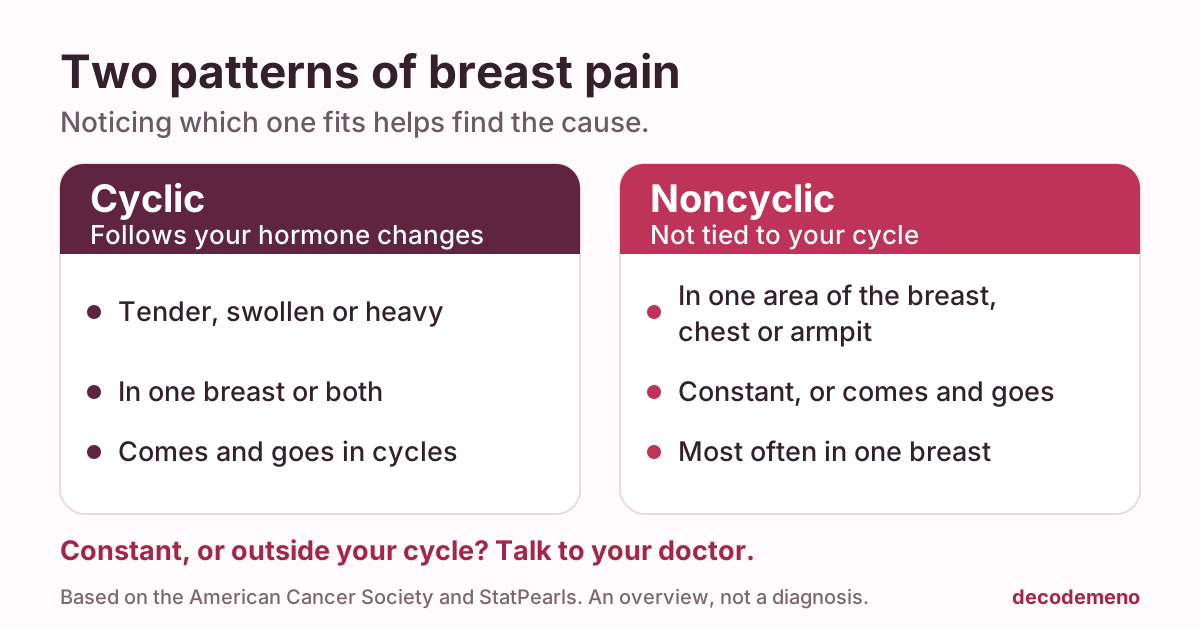
StatPearls says noncyclic pain usually affects women aged 40 or older, often in perimenopause. It is linked more to things like cysts, injury or large breasts than to hormones. ACS says to talk to your doctor if pain is constant or comes and goes outside your cycle.
Breast pain in menopause: does it ease?
Often, yes. Cleveland Clinic says you are much less likely to have breast soreness once you enter menopause. StatPearls says breast pain is most common before menopause and in perimenopause, and rare afterward. Hormone therapy is an exception: Cleveland Clinic says it can cause breast pain at any stage of life.
Is it hormones or something else?
This table is a starting point for a talk with your doctor, not a test.
| What you notice | What it may be | What the sources say |
|---|---|---|
| Both breasts feel tender or heavy, and it rises and eases with your cycle | Hormone-related (cyclic) pain | ACS: hormone changes are the most common cause. |
| It began after a new medicine, birth control or hormone therapy | A medicine | ACS lists birth control pills and hormone treatments. MedlinePlus adds estrogen replacement therapy, water pills (diuretics) and some antidepressants (SSRIs). Talk to your doctor before changing any medicine. |
| Your period is late and your breasts are tender | Pregnancy | Pregnancy is still possible in perimenopause (Cleveland Clinic). MedlinePlus says common signs of early pregnancy may include swollen, tender breasts. |
| Pain in one area, constant, or outside your cycle | Noncyclic pain: needs a check to find the cause | ACS: talk to your doctor if pain is constant or comes and goes outside your cycle. Cysts and other benign conditions might cause pain (ACS). |
| It feels like a sore muscle after a recent workout, or pressing one spot on your chest brings it on | Sore chest muscles or the chest wall | Cleveland Clinic says sore chest muscles can feel like breast pain. StatPearls says chest wall pain can too, and that breast-felt pain can also come from the heart, lungs or food pipe. Tell a doctor about persistent pain with no clear cause (MedlinePlus). |
| Your bra doesn't fit, or you hurt your breast | Bra fit or injury | ACS lists ill-fitting bras, and injury or trauma to the breast. |
For aches that seem to come from muscles or joints, see our guide to perimenopause joint pain and frozen shoulder.
Is breast pain a sign of cancer?
What US sources say:
- ACS: breast pain is not usually a sign of cancer.
- NCI: breast cancer does not usually cause pain. Cysts, hormone changes and some medicines can cause it.
- MedlinePlus: breast pain is not a common symptom of cancer.
When cancer does cause pain, ACS says it usually comes with other symptoms in the breast or nipple, and is constant, noncyclic pain that lasts more than a few weeks.
One exception: ACS says a rare type, inflammatory breast cancer, commonly causes pain. Other signs are swelling and firmness that develop quickly, and red, dimpled skin like an orange peel. Tell your healthcare team if you notice these.
"Usually" is not "never." ACS lists breast or nipple pain among possible symptoms, so pain that does not go away deserves a check. NCI also says early breast cancer often has no symptoms, which is why screening is important. ACS says to continue regular screening as recommended.
When to see a doctor
Tell a doctor if you notice any of these:
- A new lump or thick, firm area in or near the breast or under the arm (NCI, ACS, MedlinePlus).
- A change in the size or shape of a breast (NCI).
- Nipple discharge that is not breast milk, especially if bloody, clear like water or pinkish (ACS, MedlinePlus).
- Skin changes such as dimpling or puckering, redness, scaly or thickened skin, or swelling (NCI, ACS, MedlinePlus).
- A nipple turning inward when it normally doesn't (ACS, NCI, MedlinePlus).
- Pain that is constant or persistent, or that comes and goes outside your cycle (ACS, MedlinePlus, NCI).
- Signs of infection such as redness, pus or fever (MedlinePlus).
- Pain that lasts and affects your sleep or daily life (ACS, StatPearls).
- New breast tenderness after menopause, especially in one breast (Cleveland Clinic).
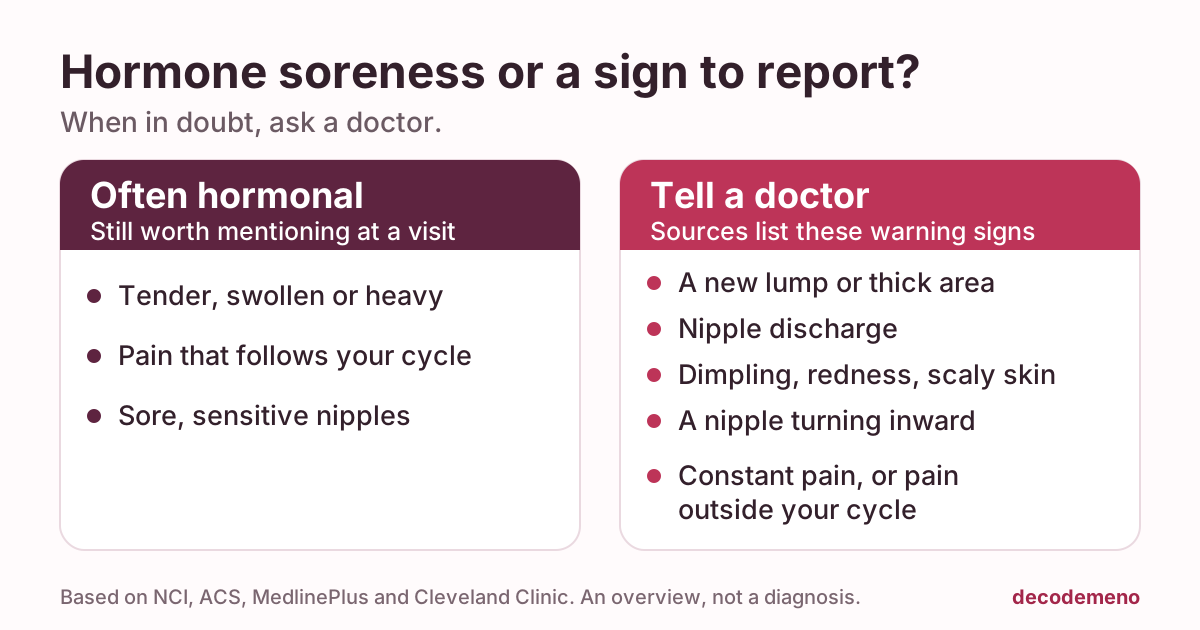
NCI says to follow up on a breast change even if you had a recent normal mammogram. A doctor will examine your breasts and may suggest tests. Ask what applies to you.
Before your visit, note when your pain happens and whether it follows your cycle. Cycles can be unpredictable in perimenopause (Cleveland Clinic), so a log of pain days and period days may help your care team see a pattern (ACS).
What may ease sore breasts, according to the sources
Ask your doctor what fits you. StatPearls says the evidence for these measures is limited.
- A well-fitting, supportive bra, such as a sports bra (MedlinePlus).
- Heat or ice on the breast (MedlinePlus).
- Regular exercise, less stress and enough sleep, suggests a Cleveland Clinic ob-gyn.
- Caffeine and diet: sources disagree. Cleveland Clinic suggests trying less caffeine. MedlinePlus says there is no good evidence that cutting fat, caffeine or chocolate helps.
- Supplements: MedlinePlus says most studies of the supplements it lists have not shown a benefit. Talk to your provider before starting any medicine or supplement.
If pain keeps you awake, see our guide to perimenopause sleep problems.
Want to see how your symptoms add up? Our free 5-minute quiz uses your age, your cycle and 21 common symptoms, scored on the Greene Climacteric Scale. Breast pain is not one of them, so it can't tell you why your breasts hurt, but it can show how your other symptoms add up. It gives you an estimate of your phase, not a diagnosis. You see your result before we ask for your email, and you can skip that step. A detailed personal report is available for a fee if you want one. Take the free perimenopause quiz
Frequently asked questions
Can perimenopause cause breast pain in one breast? Yes. Cleveland Clinic says it can be in one breast or both. Pain that stays in one spot and does not go away should be checked (ACS, NCI).
Can perimenopause cause breast lumps? Cleveland Clinic says benign cysts can form in perimenopause and make breasts more tender, more often with hormone therapy. It says to see your provider about any new lump.
Can perimenopause cause sore nipples? Cleveland Clinic lists nipple pain and sensitivity. After menopause, duct ectasia may cause tender nipples (NCI). Nipple discharge or a nipple that turns inward is a reason to see a doctor.
Can hormone therapy make my breasts sore? It can. Cleveland Clinic says hormone therapy can cause breast pain, and ACOG lists temporary breast soreness as a possible side effect. ACOG says to talk with your ob-gyn if it troubles you or lasts longer than expected.
Sources
- American Cancer Society. Does Breast Pain Mean Cancer? and Signs and Symptoms of Breast Cancer. Accessed October 2026.
- National Cancer Institute. Breast Cancer Signs and Symptoms and Benign and Precancerous Breast Lumps and Conditions. Accessed October 2026.
- MedlinePlus. Breast pain, Breast lump and Pregnancy Test. Accessed October 2026.
- Cleveland Clinic. Does Menopause Cause Breast Pain? and Perimenopause. Accessed October 2026.
- Tahir MT, et al. Mastalgia. StatPearls. Treasure Island (FL): StatPearls Publishing; 2025. Hosted by the National Library of Medicine.
- American College of Obstetricians and Gynecologists. Hormone Therapy for Menopause. Accessed October 2026.
This article is for education. It isn't medical advice and doesn't replace a visit with your doctor. Decodemeno sells a personal perimenopause report. Sources checked October 29, 2026.