
Perimenopause may play a part in hair loss, but it is not the only cause. The most common type in women, female pattern hair loss (thinning on top that runs in families), often starts in midlife, and falling estrogen may help speed it up. Thyroid problems, too little iron, stress and some medicines can also cause hair loss. A dermatologist can often tell which type you have.
Curious where you are in the transition? Our free perimenopause quiz takes about five minutes.
In short
- Female pattern hair loss is the most common cause of hair loss in women, says the American Academy of Dermatology (AAD).
- Heavy shedding is usually temporary. The AAD says it starts a few months after a trigger, and most people see normal fullness return within 6 to 9 months once the shedding stops.
- The link between perimenopause and hair loss is suspected, not settled. The North American Menopause Society says falling estrogen may play a role in speeding up female pattern hair loss.
- Other causes of hair loss are worth ruling out, so see a dermatologist (a skin and hair doctor) early, says the AAD. Finding the cause sooner improves your chance of results.
For the other symptoms of this stage, see our guide to perimenopause symptoms.
What kind of hair loss do you have?
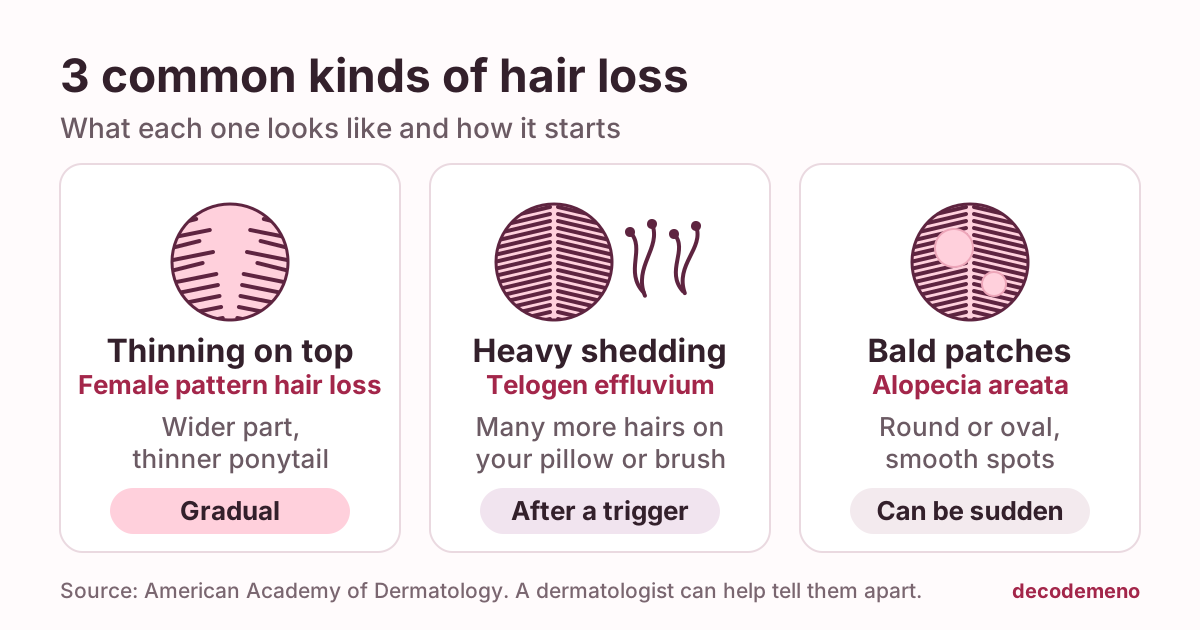
The AAD says it's normal to shed 50 to 100 hairs a day. Find your closest match:
| What you notice | What it may be | What to know |
|---|---|---|
| A wider part, thinner ponytail, thinner hair on top | Female pattern hair loss (runs in families) | Starts slowly and tends to continue without treatment. With this type, women do not lose all of their hair. |
| Many more hairs than usual on your pillow or brush | Heavy shedding (telogen effluvium) | Starts a few months after a trigger. Usually temporary, but it can last if the stress does. |
| Round or oval, smooth bald patches | Alopecia areata (the immune system attacks hair follicles) | Can start suddenly. Hair may regrow, but it can fall out again. |
| A hairline that recedes along the front and sides, often with thinner eyebrows | Frontal fibrosing alopecia (a scarring type) | Scars the follicles, so early treatment matters. Most women notice it about 2 to 12 years after menopause starts, but it can begin earlier. |
Some people have more than one type.
Is it the hormones? How sure are we?
MedlinePlus says pattern hair loss in women is most likely after menopause. A 2025 review of 40 studies looked at skin conditions in menopause. Of the conditions studied, hair loss had the strongest link to menopause, especially frontal fibrosing alopecia and female pattern hair loss. Most cases appeared after menopause.
The North American Menopause Society (NAMS) says it is believed that falling estrogen may play a role in speeding up female pattern hair loss, because hair follicles have estrogen receptors. Another review reports that hair becomes less dense and thinner during the perimenopausal years.
The evidence has limits. NAMS says more studies are needed to know whether sex hormones are linked to hair loss in postmenopausal women. Age-related changes can overlap with hormone changes, so the two are hard to separate.
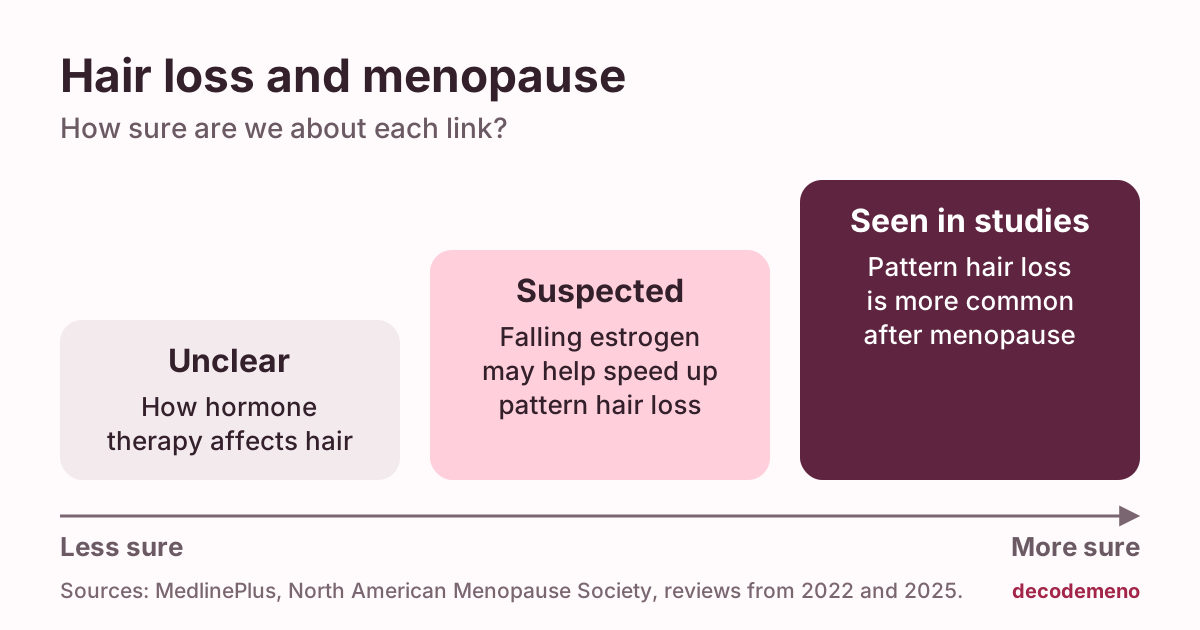
A 2022 review found insufficient evidence for hormone therapy in female pattern hair loss. The 2025 review calls the evidence limited and sometimes conflicting. It linked hormone therapy to a higher risk of frontal fibrosing alopecia, but says its effect on hair loss overall is unclear. Most of the studies used hormone types that are less common today. If you discuss hormone therapy for other symptoms, ask how it might affect your hair.
Noticing other changes too? Our free 5-minute quiz uses your age, your cycle and 21 common symptoms, scored on the Greene Climacteric Scale. It gives you an estimate of your phase, not a diagnosis. You see your result before we ask for your email, and you can skip that step. A detailed personal report is available for a fee ($39, one time) if you want one. Take the free perimenopause quiz
What else can cause hair loss?
The AAD says other causes can look like female pattern hair loss. Without an accurate diagnosis, treatment is often ineffective. Worth ruling out:
- Thyroid disease. Thyroid problems can cause hair loss, says MedlinePlus, and the AAD says treating them can reverse it.
- Too little iron, protein, zinc or biotin. The AAD says hair can regrow once you get enough.
- Stress, illness, surgery or weight loss. The AAD lists lots of stress, a high fever, an operation, losing 20 pounds or more and stopping birth control pills as shedding triggers. Eating too few calories can also cause hair loss. If you are trying to lose weight, see our guide to perimenopause weight gain.
- Medicines. Hair loss is a possible side effect of some. If you suspect one, ask the doctor who prescribed it, and do not stop it before you talk with them, says the AAD.
- Heavy periods. Periods may get heavier in perimenopause, says the Office on Women's Health. The National Heart, Lung, and Blood Institute says heavy periods raise the risk of iron-deficiency anemia (anemia caused by too little iron). Anemia may cause tiredness, and the AAD says too little iron can cause hair loss.
What might a dermatologist suggest?
A dermatologist starts by looking for the cause. If they suspect a disease, vitamin deficiency, hormone imbalance or infection, you may need a blood test or a scalp biopsy (a small skin sample).
No single treatment works for everyone, says the AAD. Some hair loss, such as shedding after an illness, regrows on its own. For female pattern hair loss, the AAD lists these options a dermatologist may discuss:
- Minoxidil, a medicine you apply to the scalp. The AAD calls it the most-recommended treatment. Results take about 6 to 12 months, and the benefit ends when it is stopped. The AAD says women who are pregnant, planning a pregnancy or breastfeeding should avoid it.
- Prescription pills. They are approved for other conditions, not for this type of hair loss, and may cause birth defects.
- Hair transplant. It may suit some women.
- At-home laser devices and platelet-rich plasma (injections made from your own blood). The AAD says early findings are promising but more studies are needed.
- Wigs and concealers. They cannot regrow hair, but give immediate results and can boost self-esteem.
The AAD says the choice of prescription medicine depends on the cause of your hair loss, your health, age, expected results and plans for pregnancy. Pregnancy is still possible in perimenopause, says Cleveland Clinic, so bring it up. The AAD also suggests gentle hair care and avoiding tight hairstyles.
When to see a doctor
The AAD advises seeing a board-certified dermatologist when hair loss worries you, since some causes need early care. Watch for these signs:
- A bald patch or strip that appears within 1 or 2 days, clumps of hair coming out when you brush, or most of your hair falling out.
- Intense itching, burning or tenderness where you are losing hair, which can mean an infection.
- Scaly bald patches with sores or blisters that ooze pus, which often mean a fungal infection of the scalp.
- A hairline that recedes along the front and sides, or thinning eyebrows. These can be frontal fibrosing alopecia, and early treatment can stop further loss, says the AAD.
Questions to bring to your appointment
Bring your symptoms, health history, any hormone therapy you have used and when you last had a period (Office on Women's Health). Add when your hair loss started, how fast it came on, and every medicine and supplement you take (AAD). Then ask:
- Is this shedding, pattern thinning or something else?
- Do I need blood tests, such as thyroid or iron?
- Could a medicine I take be involved?
- Which options fit my type, and when would I know if one works?
- If I could still get pregnant, which options are safe?
If you feel worn out too, see our guide to perimenopause fatigue.
Frequently asked questions
Does perimenopause hair loss grow back? It depends on the cause, says the AAD. After heavy shedding stops, most people see normal fullness within 6 to 9 months. In female pattern hair loss, treatment can help regrow hair and works best when started early.
Does it start at the temples or at the part? In female pattern hair loss, the part often gets wider and hair near the temples may recede, says the AAD. A receding hairline along the front and sides, often with thinner eyebrows, can be frontal fibrosing alopecia, so get it checked.
Do hair loss shampoos or supplements work? Hair loss shampoos can make hair look fuller but cannot regrow hair or stop the loss from getting worse, says the AAD. Findings on supplements such as biotin are mixed, and most studies found no effect on hair growth or thickness. The AAD warns that biotin, iron or zinc supplements can be harmful when your levels are normal, and a blood test can show whether you are low.
Sources
- American Academy of Dermatology. Hair loss pages: female pattern hair loss, causes, shedding, early signs, alopecia areata, its symptoms, frontal fibrosing alopecia, diagnosis and treatment, tips. Accessed October 2026.
- MedlinePlus (National Library of Medicine). Hair Loss and Androgenetic alopecia. Accessed October 2026.
- North American Menopause Society (now The Menopause Society). More Than Half of Postmenopausal Women Experience Female Pattern Hair Loss. 2022.
- Office on Women's Health. Menopause symptoms and relief. Accessed October 2026.
- Cleveland Clinic. Perimenopause. Accessed October 2026.
- National Heart, Lung, and Blood Institute (NIH). Iron-Deficiency Anemia. Accessed October 2026.
- Kamp E, et al. Menopause, skin and common dermatoses. Part 1: hair disorders. Clin Exp Dermatol. 2022.
- Grymowicz M, et al. Hormonal effects on hair follicles. Int J Mol Sci. 2020.
- Roster K, et al. Menopause and common dermatoses: a systematic review. Am J Clin Dermatol. 2025.
This article is for education. It isn't medical advice and doesn't replace a visit with your doctor. Decodemeno sells a personal perimenopause report. Sources checked October 28, 2026.