
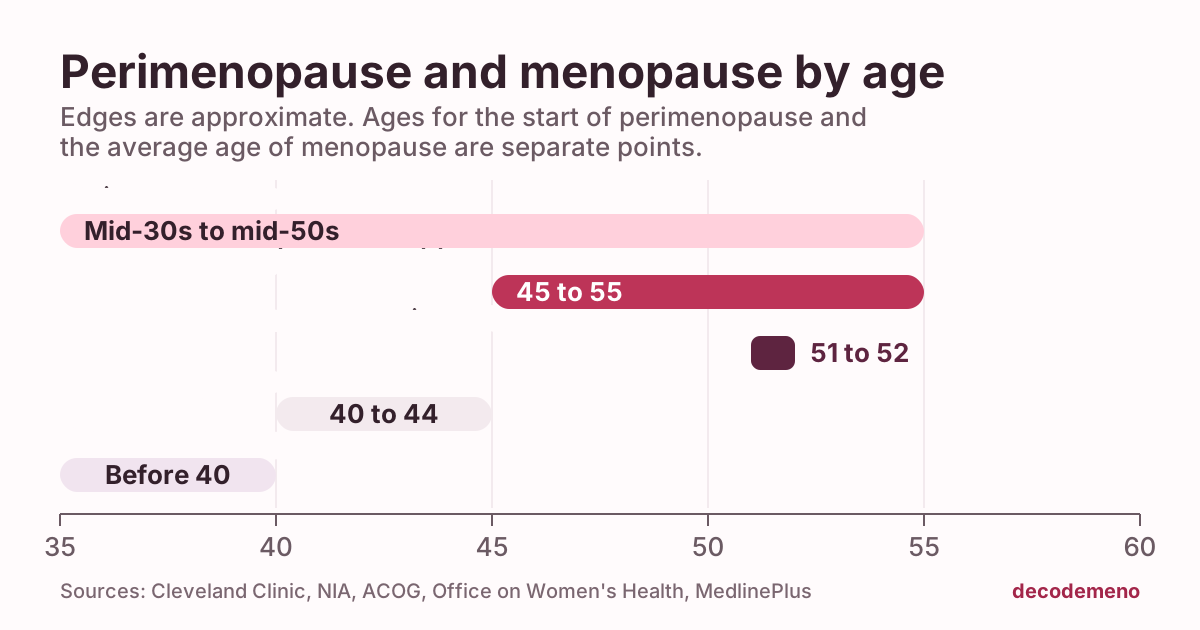
Perimenopause usually starts in your 40s, often in the mid-40s, but it can begin as early as your mid-30s. The National Institute on Aging says most women begin it between ages 45 and 55. It lasts about four years on average, and some sources say up to 8 or 10 years. The average age of menopause in the US is 51 to 52.
Want an estimate of where you are now? Our free perimenopause quiz takes about 5 minutes.
In short
- Perimenopause usually starts in your 40s. Cleveland Clinic says the mid-40s, and the National Institute on Aging (NIA) says most women begin it between ages 45 and 55. It can start as early as the mid-30s.
- The average age of menopause in the US is 51 to 52. ACOG, the American College of Obstetricians and Gynecologists, says 51, and the NIA says 52. Menopause is the day you reach 12 months without a period.
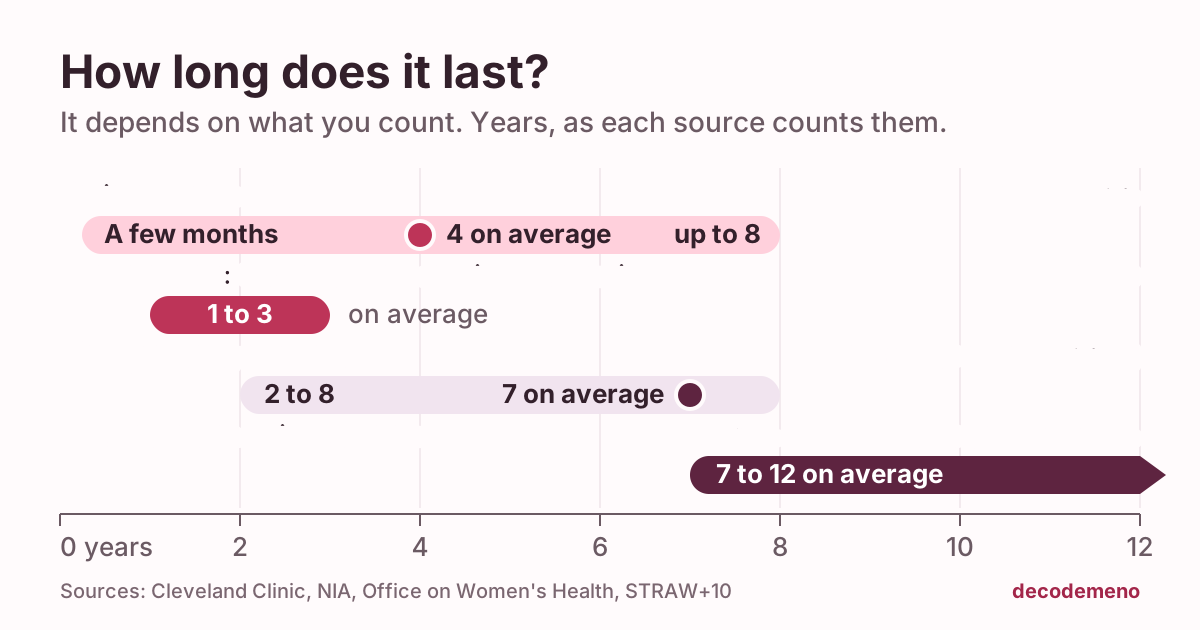
- Perimenopause lasts about four years on average. Cleveland Clinic says it can last a few months or up to 8 years. The Office on Women's Health says up to 10 years.
- Menopause before 45 is called early, and before 40 is called premature. If your periods stop or become irregular before 45, tell your doctor.
- Your age alone can't tell you which stage you are in. The NIA says timing and symptoms are highly variable among women.
For the symptoms themselves, see our guide to perimenopause symptoms.
At what age does perimenopause start?
Most sources put the usual start in your 40s, and they say it can start earlier. This table shows how each one words it. It also keeps two events apart: when perimenopause starts, and when menopause arrives.
| Source | When perimenopause starts | Age of menopause |
|---|---|---|
| ACOG | The estrogen your ovaries make starts to go up and down in your 30s and 40s | Average 51 |
| NIA | Most women begin it between 45 and 55 | Average 52 in the US |
| Cleveland Clinic | Usually the mid-40s, and as early as the mid-30s | Average 52 in the US, or around 51 on another of its pages |
| Office on Women's Health (OWH) | Usually the mid- to late 40s, and some women notice symptoms in their mid- to late 30s | Average 52 in the US |
| MedlinePlus | Usually in your 40s, sometimes earlier | Most common between 45 and 55 |
| The Menopause Society | Not given on this page | Normal range 46 to 55 |
| SWAN paper | Cites a median age of 47.5 for the start of late perimenopause (from earlier studies) | Median age at the final period: 52.5 |
Watch the wording. The NIA uses 45 to 55 for when perimenopause begins. MedlinePlus uses 45 to 55 for the most common ages of reaching menopause. These are two different points in time.
ACOG says a change in your cycle is a common sign of perimenopause. For more on that, see our guide to perimenopause periods. The sources we read don't say how many women start in their 30s, so treat the mid-30s as possible, but not typical.
SWAN is the Study of Women's Health Across the Nation, a long-term US study funded by the NIH. The SWAN paper cites a median age of 47.5 for the start of late perimenopause (from earlier studies). A median is the middle value in a group. The paper defines late perimenopause as no period for 3 months, with at least one in the past 12 months.
What is the average age of menopause in the US?
The average age of menopause in the US is 51 to 52. ACOG says 51. The NIA, the OWH and Cleveland Clinic say 52. In SWAN, the median age at the final period was 52.5.
Menopause is one point in time: the day you reach 12 months in a row with no period or spotting. The NIA says you only know you've reached it once that full year has passed.
An average is not a deadline. The NIA says women reach menopause at different ages, and Cleveland Clinic says there is no crystal ball for when you will reach it. To see how menopause fits with the stages around it, read our guide to perimenopause, premenopause and menopause.
How long does perimenopause last?
Cleveland Clinic puts the average at about four years. It says some women are in perimenopause for only a few months, and for others it lasts up to 8 years. The OWH also says about four years on average, and up to 10 years.
STRAW+10 is a staging system for research and clinical use. It uses your periods to mark two steps on the way to your final period:
- Early step: the length of your cycle keeps changing by 7 days or more from one cycle to the next.
- Late step: you go 60 days or more without a period. This step lasts 1 to 3 years on average, and hot flashes are likely during it.
According to STRAW+10, perimenopause ends 12 months after your final period.
Symptoms are a separate question, and the numbers differ by source:
- The NIA says symptoms related to menopause can last between 2 and 8 years.
- Cleveland Clinic gives an average of about 7 years for menopause symptoms.
- The OWH says hot flashes and night sweats last 7 to 12 years on average, and longer for some women.
So the stage and your symptoms don't always end at the same time. If symptoms bother you, the NIA advises talking with a doctor about lifestyle changes or medicines that might help.
What counts as early or premature menopause?
Two age cutoffs apply to menopause itself, meaning your final period:
- Premature menopause is menopause before age 40. MedlinePlus, the OWH, Cleveland Clinic and The Menopause Society all use this cutoff.
- Early menopause is menopause before age 45, according to MedlinePlus and Cleveland Clinic. The OWH words it as between 40 and 44.
These cutoffs describe when your periods stop for good. They are not the age perimenopause starts.
Both affect a minority of women. Cleveland Clinic says about 1 in 100 women have premature menopause and 1 in 20 have early menopause (before 45). The Menopause Society says about 3 in 100 go through menopause before 40. The estimates differ.
A related condition is primary ovarian insufficiency (POI). MedlinePlus says it happens when your ovaries stop working normally before 40. With POI you may still have periods, and you might still be able to get pregnant. Sources word its link to premature menopause differently, so ask your doctor which applies to you.
The OWH says years without estrogen raise your risk of bone loss, heart disease and diabetes. For early or premature menopause, the OWH says hormone therapy (estrogen, sometimes with progestin) may help relieve symptoms and protect your bones. You and your provider can decide together whether it is right for you.
What can change when perimenopause starts?
Sometimes there is no clear cause for early or premature menopause, says the OWH. But sources link a few things to earlier timing:
- Smoking. Cleveland Clinic says people who use tobacco regularly tend to go into menopause about 1 to 2 years earlier, and calls it the only lifestyle factor that may cause early menopause. The NIA says smoking is associated with an early onset of menopause and more severe symptoms. If you smoke, MedlinePlus advises trying to quit, for hot flashes and for your overall health.
- Family history. The OWH lists a family history of early menopause.
- Medical treatment and conditions. The OWH lists chemotherapy, pelvic radiation, autoimmune conditions such as thyroid disease, and genetic conditions such as Turner syndrome.
- Surgery. Surgery that removes both ovaries starts menopause right away, says the OWH. Removing the uterus alone stops your periods but doesn't cause menopause unless the ovaries are also removed, says MedlinePlus. After a hysterectomy, your periods can't show your stage, according to STRAW+10.
The NIA says timing and symptoms are likely shaped by genetics. It names outside factors too: race and ethnicity, culture, lifestyle and environment.
Perimenopause at 35, 40, 45, 47 and 50
Your age tells you what is typical, not what you are feeling. The NIA says the timing and the symptoms are highly variable among women. The NIA says a change in your period might be what you notice first. Read this table as ranges, not rules.
| Age | What the sources say | What to do |
|---|---|---|
| 35 | Possible but earlier than the usual start: Cleveland Clinic says perimenopause may begin as early as the mid-30s. A drop in fertility, which often begins around 35, is not the same as menopause. | Other conditions can also cause irregular bleeding, so tell your doctor about changes. If you are under 40 and have missed 3 or more periods, see a healthcare professional. |
| 40 | Inside the range the sources give. MedlinePlus says the 40s; Cleveland Clinic says the usual start is the mid-40s. | If your periods stop or become irregular before 45, tell your provider. |
| 45 | The usual start. Cleveland Clinic says the mid-40s, and the NIA's range for the start of perimenopause begins at 45. | Track your periods and symptoms, and share them with your provider. |
| 47 | Close to the median of 47.5 for late perimenopause that the SWAN paper cites. Women vary. | The same as at 45. |
| 50 | Close to the average age of menopause, 51 to 52. You may be in perimenopause or past it. You have reached menopause only after 12 months with no period or spotting. | Until then, pregnancy is still possible. Bleeding after that year is a reason to see a doctor. |
No source we read ties a symptom to a particular age. The NIA lists common changes such as period changes, hot flashes, night sweats, trouble sleeping and mood changes. ACOG says some women have no symptoms or only a few mild ones, while others have many that can be severe. Some symptoms look like those of other conditions, so Cleveland Clinic advises talking with your provider. Our guide to perimenopause symptoms lists them all.
Want to see how your symptoms add up? Our free 5-minute quiz uses your age, your cycle and 21 common symptoms, scored on the Greene Climacteric Scale. It gives you an estimate of your phase, not a diagnosis. You see your result before we ask for your email, and you can skip that step. A detailed personal report is available for a one-time fee of $39 if you want one. Take the free perimenopause quiz
When to see a doctor
Changes in your periods are normal in perimenopause. ACOG still says to report them to your health care professional, because abnormal bleeding may be a sign of a problem.
Some reasons depend on your age:
- You are under 40 and have missed 3 or more periods. The Menopause Society advises seeing a healthcare professional to find out whether it is POI or another cause.
- Your periods stop or become irregular before 45. The OWH says to tell your provider, who may order blood tests. Cleveland Clinic also lists skipping periods before 45 as a reason to get in touch.
- You have signs of menopause before 40. Cleveland Clinic says to contact a healthcare provider.
Other reasons apply at any age. The NIA advises seeing your doctor if:
- your periods come very close together
- you have heavy bleeding
- you bleed or spot after sex or between periods
- your periods last more than a week
- you bleed or spot again after more than a year without a period
Cleveland Clinic adds very heavy periods with large blood clots, changing a pad or tampon every 1 to 2 hours, and periods less than 21 days apart. The OWH says vaginal bleeding after menopause is not normal, and to see your provider right away. Also see a doctor if your symptoms are hard to bear or get in the way of your quality of life, says Cleveland Clinic.
What a visit involves. Your provider can usually tell whether you are in perimenopause from your age, your symptoms and changes in your periods, says the OWH. Blood hormone tests are not usually needed, and Cleveland Clinic says hormone levels change so much that the tests aren't reliable. If you are weighing a test, see our guide to the perimenopause test.
Before your visit, track your periods and symptoms, as the OWH advises. Cleveland Clinic suggests keeping a cycle journal and asking:
- Are these symptoms of perimenopause?
- How long do you think I will have these symptoms?
- Are there any tests that should be done?
- Would hormone therapy be an option for me?
Frequently asked questions
Can perimenopause start in your 30s? Yes, it can. Cleveland Clinic says it may begin as early as your mid-30s, and the OWH says some women notice symptoms in their mid- to late 30s. That is earlier than the usual start in the 40s, so tell your doctor about changes.
Is perimenopause at 40 normal? It falls within the range the sources give. Cleveland Clinic gives the mid-40s as the usual start, and MedlinePlus says the 40s. If your periods stop or become irregular before 45, the OWH says to tell your provider.
How long does perimenopause last? About four years on average, according to Cleveland Clinic and the OWH. It can be a few months, or up to 8 years (Cleveland Clinic) or 10 years (OWH).
When does perimenopause end? STRAW+10 says perimenopause ends 12 months after your final period. That is the point when you have reached menopause.
More on age and phases
- Perimenopause vs premenopause vs menopause
- Perimenopause periods
- Perimenopause test
- Perimenopause symptoms: the full list
- All Decodemeno guides
Sources
- American College of Obstetricians and Gynecologists. The Menopause Years (patient FAQ). Accessed October 2026.
- National Institute on Aging. What Is Menopause? Accessed October 2026.
- Cleveland Clinic. Perimenopause. Accessed October 2026.
- Cleveland Clinic. Menopause. Accessed October 2026.
- Cleveland Clinic. Premature and Early Menopause. Accessed October 2026.
- Office on Women's Health, U.S. Department of Health and Human Services. Menopause basics. Accessed October 2026.
- Office on Women's Health, U.S. Department of Health and Human Services. Early or premature menopause. Accessed October 2026.
- MedlinePlus, National Library of Medicine. Menopause. Accessed October 2026.
- The Menopause Society. Premature Menopause (patient education). Accessed October 2026.
- Gold EB, et al. Factors related to age at natural menopause: longitudinal analyses from SWAN. American Journal of Epidemiology. 2013.
- Harlow SD, et al. Executive summary of the Stages of Reproductive Aging Workshop + 10 (STRAW+10). 2012.
This article is for education. It isn't medical advice and doesn't replace a visit with your doctor. Decodemeno sells a personal perimenopause report. Sources checked October 28, 2026.