
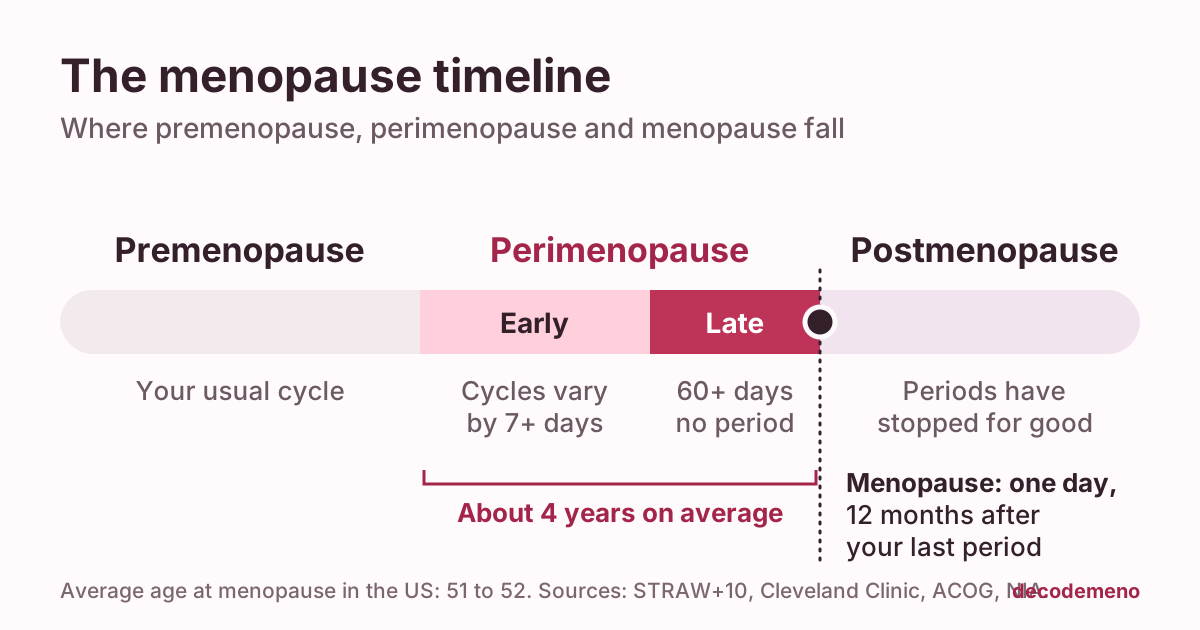
Premenopause is an everyday word, used here for the years before the menopause transition begins. Perimenopause is the transition itself: your periods start to shift, and symptoms like hot flashes or poor sleep can show up. Menopause is a single day, confirmed once you've gone 12 months without a period. Every day after it is postmenopause.
Not sure which one fits you? The 4-question check below takes a minute, and our free perimenopause quiz takes five.
In short
- Premenopause is not one of the stages in STRAW+10, the staging system experts use. It's an everyday word, used here for the years before any change.
- STRAW+10 marks the start of perimenopause when your cycle length keeps changing by 7 days or more. Perimenopause ends 12 months after your last period.
- Perimenopause lasts about four years on average, according to Cleveland Clinic, but it can be a few months or up to eight years.
- Menopause is one day on the calendar: the day you reach 12 months without a period. In the US, the average age is 51 to 52.
- Pregnancy is still possible in perimenopause. If you don't want to get pregnant, keep using birth control until your doctor says it's safe to stop.
For the symptoms themselves, see our complete list of perimenopause symptoms.
The stages side by side
| Premenopause | Perimenopause | Menopause, then postmenopause | |
|---|---|---|---|
| What it is | Your reproductive years, before the transition | The transition, when hormone levels rise and fall | Menopause is the day you reach 12 months without a period. Postmenopause is every day after it |
| Your periods | Your usual pattern | Changing: shorter or longer cycles, skipped periods, lighter or heavier flow | Stopped for 12 months or more |
| Typical age | Until the transition starts | Most often between 45 and 55, sometimes earlier | Average age 51 to 52 in the US |
| Common symptoms | None from the transition | Hot flashes, night sweats, trouble sleeping, mood changes, joint pain | For many women, hot flashes last for many years after menopause |
| Can you get pregnant? | Yes | Yes, it's still possible | No, once your periods have stopped naturally for a full year |
Premenopause: an everyday word, not a formal stage
STRAW+10, the staging system that doctors and researchers use, names three stages: the reproductive years, the menopausal transition, and postmenopause. "Premenopause" is not one of them.
So the word gets used two ways online. Some sites use it for the reproductive years before any change. Others use it as another name for perimenopause, which is why the two words get mixed up. In this article, premenopause means the years before any change.
If your periods still come on your usual schedule, you're likely in the reproductive stage, which this article calls premenopause. If you notice new symptoms anyway, write them down for a few cycles. A pattern is easier to discuss with your doctor than a vague feeling.
Perimenopause: the transition
Perimenopause is the time around menopause. According to the American College of Obstetricians and Gynecologists (ACOG), estrogen levels can start to fluctuate in your 30s and 40s, and a change in your cycle is a common sign. Cleveland Clinic says perimenopause usually starts in the mid-40s, and the National Institute on Aging (NIA) says the transition most often begins between ages 45 and 55.
STRAW+10 uses your periods to mark two steps:
- Early perimenopause: the length of your cycle keeps changing by 7 days or more from one cycle to the next. For example, 26 days, then 34, and the change happens again within your next 10 cycles.
- Late perimenopause: you go 60 days or more without a period. This late step lasts 1 to 3 years on average, and hot flashes are likely during it.
Overall, Cleveland Clinic puts the average length of perimenopause at about four years. Our guide to perimenopause periods covers what's normal and what isn't. For some women it's a few months, and for others it lasts up to eight years.
Common symptoms include hot flashes, night sweats, trouble sleeping, mood changes and joint pain. Some of them look like symptoms of other conditions, so they're worth bringing up with your doctor.
Pregnancy is still possible in perimenopause. If you don't want to get pregnant, the NIA advises using birth control for at least 12 months after your last period. Ask your doctor when it's safe to stop.
Menopause: one day on the calendar
Menopause isn't a stage you live through. It's a point you can only see looking back: the day you reach 12 months without a period or spotting.
ACOG puts the average age at 51. The NIA puts it at 52 in the US. Every day after that point is postmenopause.
Reaching menopause before age 40 is called premature menopause. ACOG advises reporting changes in your periods to your health care professional, so if this happens to you, tell your doctor.
Symptoms: perimenopause vs. after menopause
The symptoms overlap, which is part of the confusion. The difference is mostly in your periods:
- In perimenopause, symptoms like hot flashes or poor sleep come while your periods are irregular or have stopped for less than 12 months.
- After menopause, your periods have stopped for good. For many women, hot flashes last for many years after menopause, according to the NIA.
Any bleeding or spotting after more than a year without a period is a reason to see your doctor.
Which stage are you in? A 4-question check
Under 40? Skip this check and tell your doctor about any change in your periods. Pregnancy is still possible in perimenopause, so rule it out first. Then answer in order and stop at the first "yes."
- Are you 40 or older, and have you gone 12 months in a row without a period or spotting? That matches menopause. You're now postmenopausal.
- Have you gone 60 days or more without a period? That matches late perimenopause.
- Does your cycle length keep changing by 7 days or more? That matches early perimenopause.
- None of these? Based on your periods alone, you're most likely in premenopause. If you have new symptoms, keep tracking them.
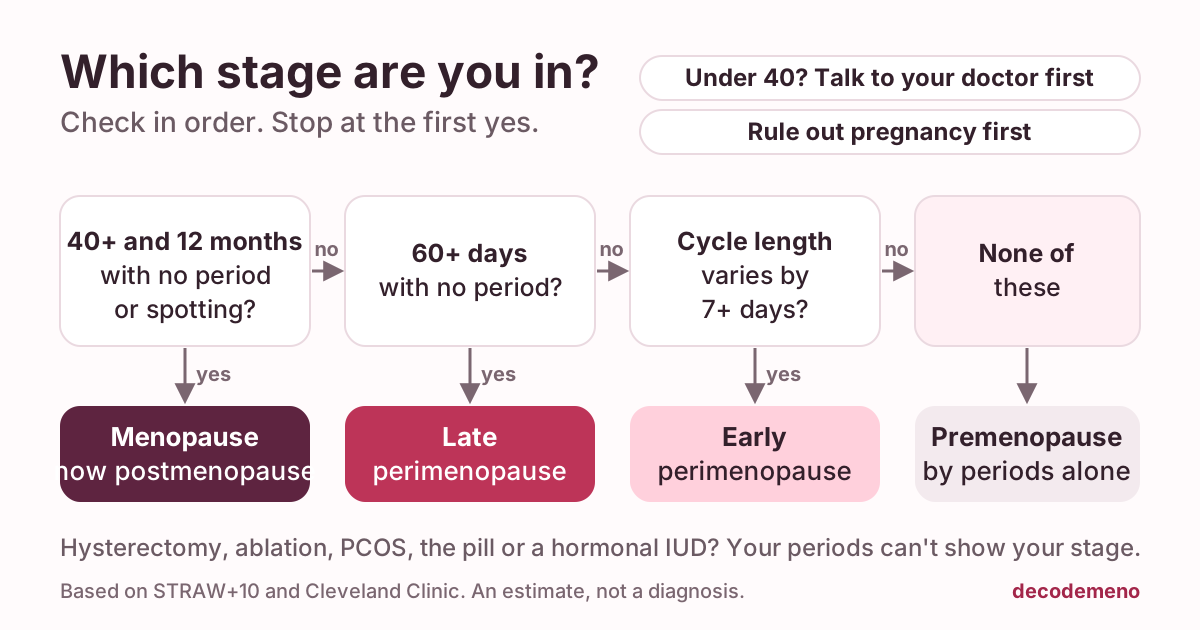
These questions don't fit everyone. After a hysterectomy or endometrial ablation, STRAW+10 says your periods can't be used to tell your stage. The same goes for PCOS (polycystic ovary syndrome). Birth control pills stabilize hormone levels, and a hormonal IUD can manage irregular bleeding, so your periods may not show your stage either, as Cleveland Clinic notes. Our quiz has an option for an IUD, an implant or a hysterectomy. For PCOS or an ablation, ask your doctor.
Want to see how your symptoms add up? Our free 5-minute quiz uses your age, your cycle and 21 common symptoms, scored on the Greene Climacteric Scale. It gives you an estimate of your phase, not a diagnosis. You see your result before we ask for your email, and you can skip that step. A detailed personal report is available for a fee if you want one. Take the free perimenopause quiz
Why a blood test often can't settle it
Many women expect a blood test to give a clear answer. In perimenopause, it often can't. As Cleveland Clinic explains, hormone levels rise and fall erratically, so an FSH (follicle-stimulating hormone) test can be misleading.
That's why doctors may use your symptoms, your age and your medical history instead. A blood test is used in some cases, for example when periods stop at an early age. Our guide to perimenopause tests explains what blood tests and home tests can and can't tell you.
When to see a doctor
ACOG notes that changes in your periods are normal in perimenopause, but you should still report them, because abnormal bleeding may be a sign of a problem. The NIA advises seeing your doctor if:
- your periods come very close together
- you have heavy bleeding
- you bleed or spot after sex or between periods
- your periods last more than a week
- you bleed or spot again after more than a year without a period
Also see a doctor if your symptoms are hard to bear or get in the way of your quality of life.
Frequently asked questions
Is premenopause the same as perimenopause? No. In this article, premenopause means the years before any change. Perimenopause is the transition, when your cycle starts to shift. Some websites use the two words as if they meant the same thing, which adds to the confusion.
Can perimenopause start in your 30s? It can. ACOG notes that estrogen levels can start to fluctuate in your 30s and 40s. Cleveland Clinic says perimenopause usually starts in the mid-40s but can start earlier.
How long does perimenopause last? About four years on average, according to Cleveland Clinic, but anywhere from a few months to eight years. The late step, with gaps of 60 days or more, lasts 1 to 3 years on average.
Can I get pregnant during perimenopause? Yes. Your periods may be irregular, but pregnancy is still possible. If you don't want to get pregnant, the NIA advises birth control for at least 12 months after your last period. Ask your doctor when it's safe to stop.
To see when each stage usually happens, read our guide to perimenopause age: when it starts and how long it lasts.
Sources
- American College of Obstetricians and Gynecologists. The Menopause Years (patient FAQ). Accessed October 2026.
- National Institute on Aging. What Is Menopause? Accessed October 2026.
- Cleveland Clinic. Perimenopause. Accessed October 2026.
- Harlow SD, et al. Executive summary of the Stages of Reproductive Aging Workshop + 10 (STRAW+10). 2012.
This article is for education. It isn't medical advice and doesn't replace a visit with your doctor. Decodemeno sells a personal perimenopause report. Sources checked October 28, 2026.