
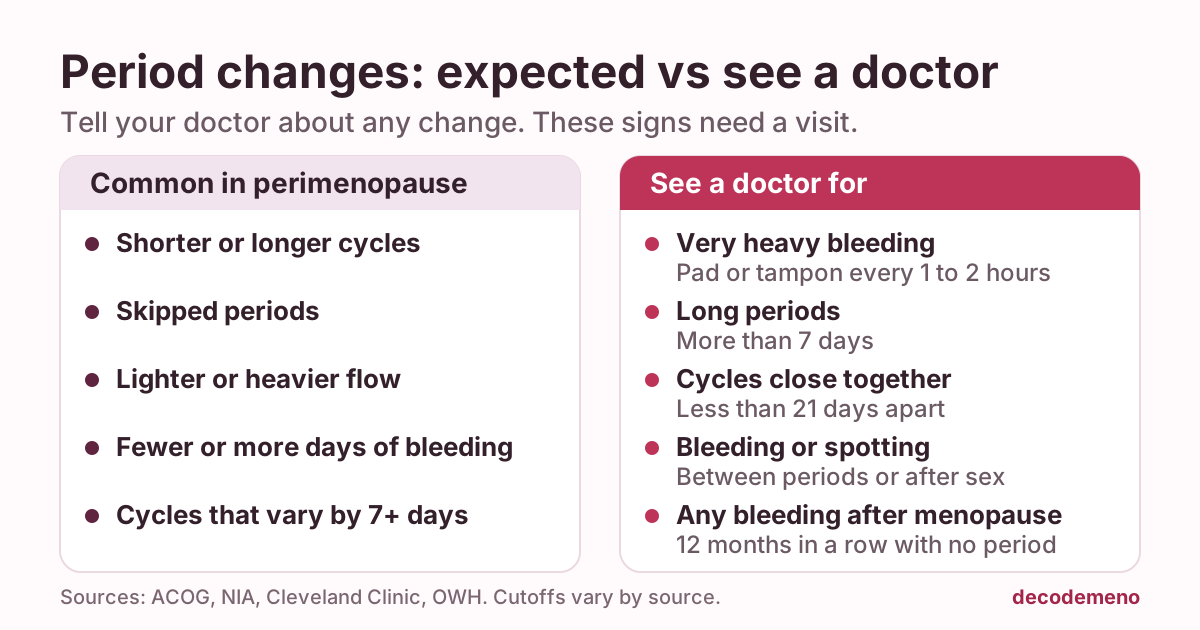
In perimenopause, your cycles may get shorter or longer, your flow may turn lighter or heavier, and you may skip periods. A skipped period can still mean pregnancy. These changes are common, but tell your doctor about them. Very heavy bleeding, periods less than 21 days apart, bleeding between periods or after sex, and any bleeding after 12 months without a period call for a visit.
Want an estimate of your phase from your cycle and symptoms? Our free perimenopause quiz takes five minutes.
In short
- Irregular periods are generally the first sign of perimenopause. Cycles may get shorter or longer, flow lighter or heavier, and you may skip periods.
- Pregnancy is still possible in perimenopause, even if you skip periods. If you don't want to get pregnant, ask your doctor when it's safe to stop birth control.
- Some bleeding calls for a visit: very heavy bleeding, periods longer than a week, cycles under 21 days apart, and any bleeding between periods or after sex.
- Any bleeding or spotting after menopause is not normal. Menopause means 12 months in a row with no period. See your health care provider right away.
- A calendar helps. Note when each period starts, how long it lasts and how heavy it is.
How do periods change in perimenopause?
Perimenopause is the phase when your hormone levels and menstrual cycle begin to change, says the American College of Obstetricians and Gynecologists (ACOG). It usually begins in the mid-40s. Your periods may be shorter or longer, and the days between them may go up or down. Your bleeding may be heavier or lighter, and you may skip periods. Longer or heavier periods are among the common changes, not only a warning sign. The cause is hormonal: your ovaries make less estrogen, and some months they release an egg while other months they don't.
The Menopause Society describes how the changes tend to unfold. At first they are often subtle, and it's common for cycles to get a little shorter. The number of days you bleed may be fewer or greater. Later, cycle length may vary by 7 days or more. In the late stage, you may skip 60 days or more. Everyone's body is different, says Cleveland Clinic, so your own pattern may differ.
For hot flashes, sleep and mood, see our guide to perimenopause symptoms. For timing, read when perimenopause starts and how long it lasts.
What the 7-day and 60-day markers mean
Healthcare providers use a staging system called STRAW+10. It sorts the stages by what your periods do:
- Early perimenopause: your cycle length differs by 7 days or more from one cycle to the next, and it happens again within 10 cycles.
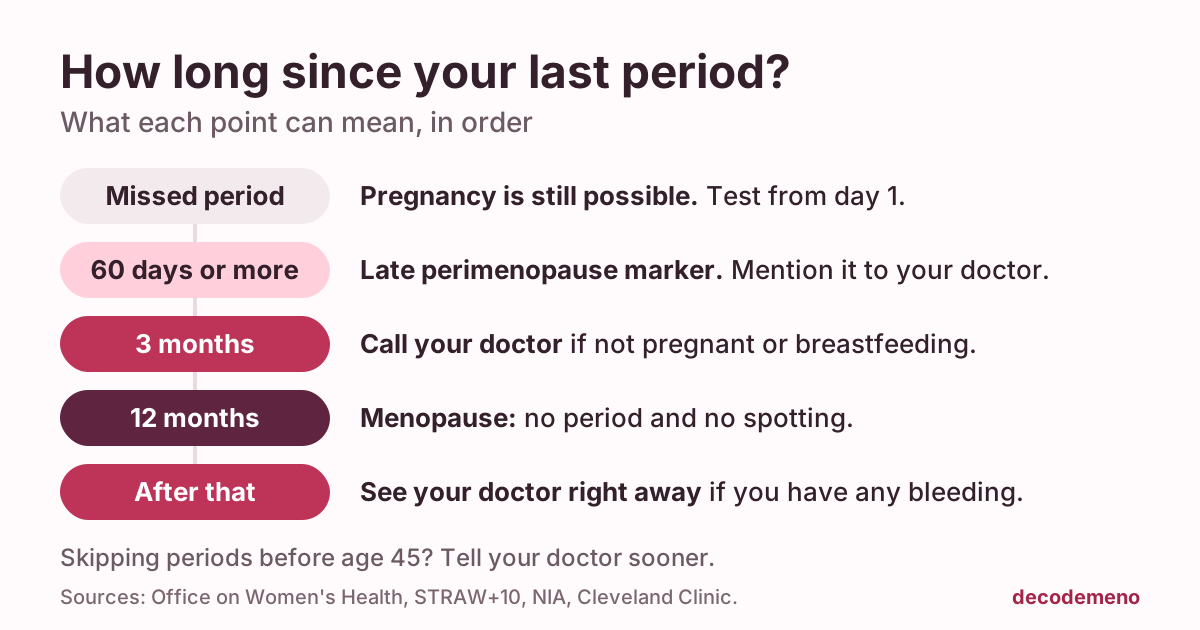
- Late perimenopause: 60 days or more without a period. This step lasts 1 to 3 years on average.
- Menopause: 12 months in a row with no period, including no spotting.
These markers describe a pattern, not a diagnosis. They don't work after a hysterectomy (surgery to remove the uterus) or an endometrial ablation (a procedure that destroys the lining of the uterus). The pill or a hormonal IUD can also change your bleeding. Our guide to how perimenopause differs from premenopause and menopause has a four-question check.
Missed a period: could it be pregnancy, and how long is too long?
A missed period can mean pregnancy, even in perimenopause. The Office on Women's Health (OWH) says you can get pregnant in perimenopause even if you skip periods. You can test as soon as the first day of a missed period, though results may be more accurate a little later. With irregular cycles, OWH suggests counting 36 days from the start of your last period, or four weeks from the time you had sex. If you don't want to get pregnant, the National Institute on Aging (NIA) advises birth control for at least 12 months after your last period.
If you are not pregnant, you may only skip a period now and then at first, says The Menopause Society. Still, Cleveland Clinic says to tell your provider about missed periods, whether or not they seem a problem. Your provider will want to rule out other reasons, such as a thyroid (hormone-making gland) issue. Cleveland Clinic adds that speaking up matters even more if you skip periods before age 45, or if a very heavy period follows months of skipped ones. OWH says to call your doctor after three months in a row without a period, if you are not pregnant or breastfeeding.
When to see a doctor
The NIA says changes in your periods can be normal, but it lists signs that call for a visit to make sure nothing else is going on. ACOG, Cleveland Clinic and OWH list similar ones, with slightly different cutoffs. Use the numbers as a guide.
| What you notice | Where the sources draw the line |
|---|---|
| Heavy flow | Soaking a pad or tampon every hour (ACOG), or changing one every one to two hours (Cleveland Clinic, OWH). Clots larger than a quarter (OWH). |
| Long periods | More than 7 days (ACOG) or longer than a week (NIA, Cleveland Clinic). |
| Cycles close together | Less than 21 days apart (ACOG, Cleveland Clinic). OWH says more often than every 24 days. |
| Bleeding or spotting between periods | Any (ACOG, NIA, Cleveland Clinic). |
| Bleeding or spotting after sex | Any (ACOG, NIA, Cleveland Clinic). |
| Bleeding or spotting after 12 months with no period | Any (ACOG, NIA, OWH). |
Cleveland Clinic also lists significant cramping. ACOG's longer list adds cycles that vary by more than 7 to 9 days, and going 3 to 6 months without a period. Both can be part of perimenopause. ACOG still advises talking with your doctor about any abnormal bleeding.
Get emergency care right away if you change a pad or tampon every hour for more than 2 hours in a row and also have chest pain, shortness of breath, and feel lightheaded or dizzy, says ACOG. OWH says to call your doctor if you feel dizzy, lightheaded, weak or tired, or have chest pain or trouble breathing during or after your period. These can be signs of anemia (blood that can't carry enough oxygen because of low iron).
Bleeding after menopause is not normal, says OWH. That means any bleeding after 12 months in a row with no period. See your health care provider right away. ACOG says it can range from light spotting to a flow like a regular period. An ACOG doctor writes that chances are there is no reason for panic, but only a careful evaluation can be sure. Cancer is the most serious cause, but also the least likely.
Other conditions can look like perimenopause. Cleveland Clinic lists infection, fibroids and polyps (noncancerous growths in the uterus), blood clotting disorders and cancer as possible causes of abnormal bleeding. Your provider may want to rule them out.
What to expect at the visit. ACOG says you should be asked about your health history, medicines and birth control, and should have a physical and pelvic exam. Tests may include a blood count (a blood test that can show anemia or infection), a pregnancy test and an ultrasound. OWH says blood hormone tests are not usually needed to tell if you are in perimenopause. Our guide to perimenopause tests explains more.
For irregular or heavy bleeding, ACOG says medicines are often tried first, and some hormonal birth control methods can lighten flow and make periods more regular. Cleveland Clinic also lists a hormonal IUD (a small device placed in the uterus) for irregular bleeding. Ask your doctor about the risks and benefits.
What to bring. If you can, track your bleeding for several weeks before the visit, says ACOG. A calendar or phone app works. Note:
- the dates and length of each period
- the type of flow: light, medium, heavy or spotting
- any bleeding between periods or after sex
Cleveland Clinic suggests asking: Are these symptoms of perimenopause? Are there any tests that should be done? When should I call my provider?
Want to see how your symptoms add up? Our free 5-minute quiz uses your age, your cycle and 21 common symptoms, scored on the Greene Climacteric Scale. It gives you an estimate of your phase, not a diagnosis. You see your result before we ask for your email, and you can skip that step. A detailed personal report is available for a fee if you want one. Take the free perimenopause quiz
Frequently asked questions
Can you be in perimenopause and still have periods? Yes. Irregular periods are generally the first sign, says Cleveland Clinic. If you still get a period, even an irregular one, you are still ovulating (releasing an egg) and can get pregnant.
Can perimenopause make periods longer or heavier? Yes. The NIA says periods may last longer, and ACOG says flow may get heavier. Very heavy bleeding or periods over a week are also reasons to see your doctor.
Is spotting between periods normal in perimenopause? Not by the usual rules. ACOG says bleeding or spotting between periods is not normal, and the NIA and Cleveland Clinic list it as a reason to see your doctor.
How long can you go without a period in perimenopause? STRAW+10 marks the late step as 60 days or more without a period, and says it lasts 1 to 3 years on average. You reach menopause after 12 months in a row with no period. Tell your doctor about skipped periods along the way.
Sources
- American College of Obstetricians and Gynecologists (ACOG). Perimenopausal Bleeding and Bleeding After Menopause; Abnormal Uterine Bleeding; Bleeding After Menopause Could Be a Problem. Here's What to Know. Accessed October 2026.
- National Institute on Aging. What Is Menopause? Accessed October 2026.
- Cleveland Clinic. Perimenopause; When You Should See a Doctor About Menopause (or Perimenopause) Symptoms (January 2025). Accessed October 2026.
- Office on Women's Health. Menopause basics; Period problems; Pregnancy tests. Accessed October 2026.
- The Menopause Society. Perimenopause. Accessed October 2026.
- Harlow SD, et al. Executive summary of the Stages of Reproductive Aging Workshop + 10 (STRAW+10). 2012.
This article is for education. It isn't medical advice and doesn't replace a visit with your doctor. Decodemeno sells a personal perimenopause report. Sources checked October 28, 2026.