
No single test confirms perimenopause. Hormones such as FSH (follicle-stimulating hormone) rise and fall from day to day, so one result can mislead. Doctors can usually tell if you're in perimenopause from your age, your symptoms and changes in your periods. They may order blood tests in some cases, such as when periods stop at an early age. They may also use tests to look for other causes.
Want a starting point? Our free perimenopause quiz takes about 5 minutes and gives an estimate of your phase, not a diagnosis.
In short
- No single test confirms perimenopause. Hormones such as FSH rise and fall from day to day, so one result can mislead.
- Doctors can usually tell if you're in perimenopause from your age, symptoms and period changes. The Office on Women's Health says blood hormone tests are not usually needed.
- A doctor may order blood tests in some cases, such as when periods stop at an early age.
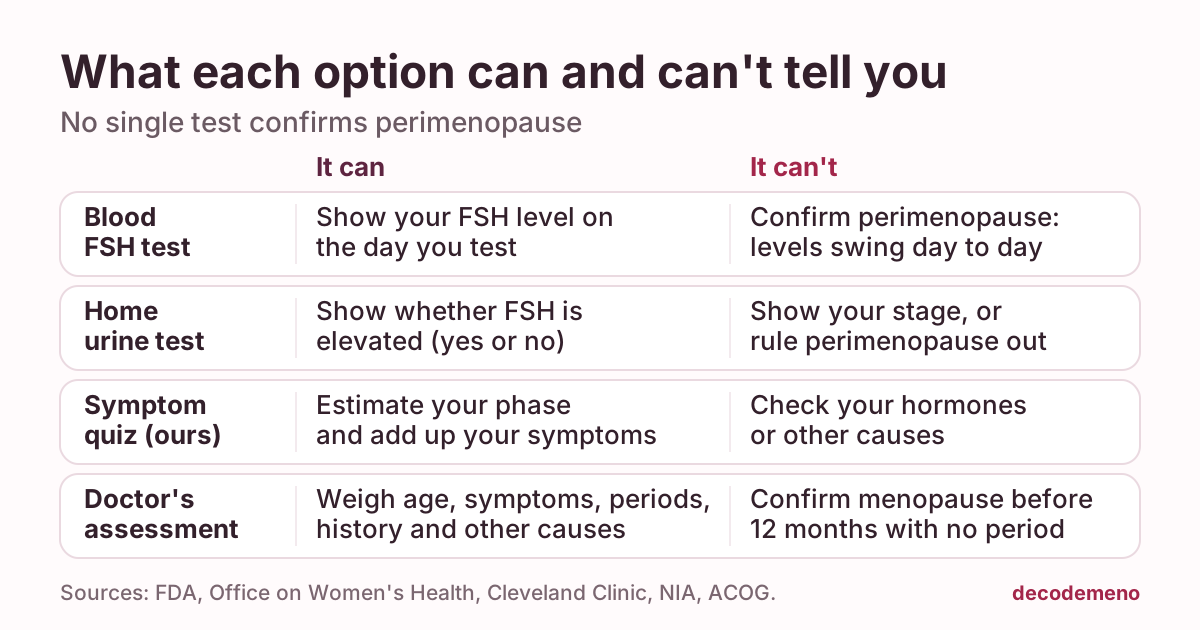
- A home urine test can't confirm perimenopause. It shows whether FSH is elevated, says the FDA.
- A symptom quiz gives an estimate of your phase, not a diagnosis. Ours uses your age, your cycle and 21 common symptoms.
For ages and stages, see our guide to when perimenopause starts.
Why can't one test confirm perimenopause?
FSH helps eggs grow and get ready for release, says MedlinePlus. A consistently high level can mean you're getting near menopause, says Cleveland Clinic. But in perimenopause your hormones rise and fall erratically, so an FSH test can be misleading. Harvard Health agrees. One FSH reading isn't reliable, because levels can swing sharply from day to day.
STRAW+10, the experts' staging system, ranks your periods as the most important sign. It calls hormone tests "supportive" only. A 2018 review says no hormone marker is useful for diagnosis yet.
Not sure what the stages are? See perimenopause, premenopause and menopause compared.
How do doctors usually decide?
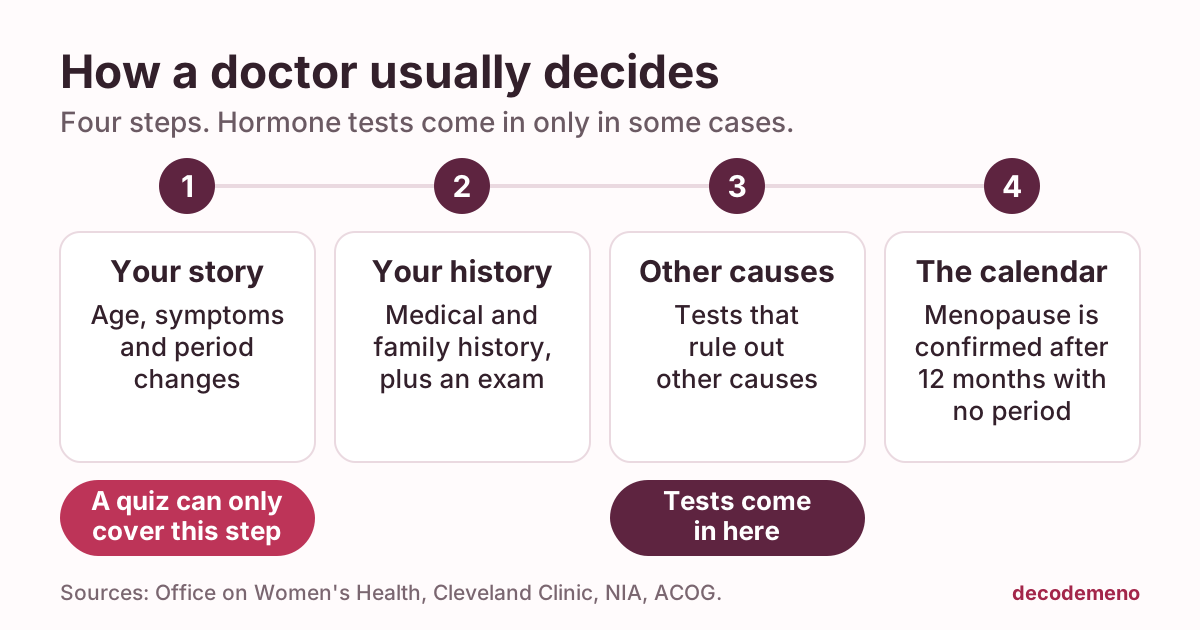
The sources describe four parts:
- Your age, symptoms and period changes. These three are usually enough, says the Office on Women's Health. A change in your periods is often the first sign, says an ob-gyn writing for the American College of Obstetricians and Gynecologists (ACOG). See our guide to perimenopause symptoms.
- Your history and an exam. Cleveland Clinic names your medical history and a physical exam. The National Institute on Aging (NIA) adds family history.
- Other causes. The same ob-gyn says doctors rule out other causes of abnormal bleeding before settling on perimenopause. Examples are thyroid problems, high levels of the hormone prolactin, uterus problems such as polyps or fibroids, and infection. Doctors use pelvic exams, blood tests and ultrasounds. If nothing else is wrong, perimenopause is the likely explanation for irregular periods, especially in your 40s.
- The calendar. You reach menopause only after 12 months with no period or spotting. So doctors usually confirm it in hindsight.
When does a doctor order a blood test?
Blood hormone tests are not usually needed, says the Office on Women's Health.
| Your situation | What the sources say |
|---|---|
| You're 45 or older and your periods are changing | An FSH test usually isn't needed (MedlinePlus). |
| Your periods stopped at an early age | A doctor may suggest a blood test to check hormone levels (NIA). If your periods stop before age 40, you can ask about testing (Office on Women's Health). |
| Your bleeding is abnormal, or your symptoms have no clear cause | Doctors look for other causes first, with pelvic exams, blood tests and ultrasounds (ACOG). MedlinePlus lists unclear symptoms as a reason for an FSH test. |
| You've had a hysterectomy (surgery to remove the uterus) | Periods can't show your stage, so doctors use hormone markers. One sample may mislead, and a repeat is often needed (STRAW+10). |
| You take hormonal birth control or other medicines | Certain medicines can affect the result of any hormone test (Cleveland Clinic). |
POI (primary ovarian insufficiency) is menopause before 40 with no medical or surgical cause. STRAW+10's criteria for it need two FSH tests at least a month apart, so one test can't settle it.
Is there an FSH level that means perimenopause?
No single level does. STRAW+10, the staging system used in research and clinics, lists FSH above 25 IU/L (international units per liter) in a blood draw not timed to your cycle as a supportive sign of late perimenopause. In that stage (60 days or more with no period), FSH is sometimes in the menopausal range. At other times it is back in the range of your earlier reproductive years. The right value also depends on the lab's method.
A high number isn't proof either. MedlinePlus links high FSH to other conditions, including POI and polycystic ovary syndrome (PCOS). Your provider reads it with your age, symptoms, history and other hormone tests.
MedlinePlus says FSH is often tested with LH (luteinizing hormone), and estrogen blood tests are also commonly used with it. AMH (anti-Müllerian hormone, made in the ovaries) is another marker. The 2018 review calls it promising but not a routine test for perimenopause.
What can a home menopause test tell you?
The FDA has a patient page on home menopause tests, current as of September 2018. It says the kits measure FSH in urine. It calls this a "qualitative test": you learn whether FSH is elevated, not whether you definitely are in menopause or perimenopause.
On accuracy, the FDA says the tests "will accurately detect FSH about 9 out of 10 times" but do not detect menopause or perimenopause. So 9 out of 10 is about measuring the hormone, not about your stage.
What the FDA says a result can and can't show:
- Positive: you may be in a stage of menopause. The FDA says to see your doctor and not to stop birth control over the result: the tests "are not foolproof and you could become pregnant."
- Negative: the FDA says not to assume you haven't reached menopause, because there could be other reasons for the result. If you have symptoms, you may be in perimenopause or menopause.
- Doctors "would not use this test by itself."
- Results can change with first-morning urine, drinking a lot of water, oral or patch birth control (now or recently stopped), hormone replacement therapy or estrogen supplements.
Can a perimenopause quiz tell you if you're in perimenopause?
No quiz can confirm it. A quiz starts where a doctor starts: your age, your symptoms and your cycle. That is only the first of the four parts above. Here is what ours can't do:
- Confirm perimenopause. No single test can.
- Measure your hormones.
- Check for other causes.
- Examine you, or tell you whether your bleeding is normal.
Want to see how your symptoms add up? Our free 5-minute quiz uses your age, your cycle and 21 common symptoms, scored on the Greene Climacteric Scale. It gives you an estimate of your phase, not a diagnosis. You see your result before we ask for your email, and you can skip that step. A detailed personal report is available for a fee ($39, one time) if you want one. Take the free perimenopause quiz
Before you see a doctor
- Track your periods and symptoms, and share them with your doctor (Office on Women's Health). Cleveland Clinic suggests noting when periods start and stop and how much you bleed.
- Cleveland Clinic suggests asking: Are these symptoms of perimenopause? Are there any tests that should be done? How long might this last? When should I call you?
When to see a doctor
Period changes are common in perimenopause. Other conditions can also cause irregular bleeding. The NIA says to see your doctor for any of these signs:
- Periods that come very close together
- Heavy bleeding
- Bleeding or spotting after sex or between periods
- Periods that last more than a week
- Bleeding or spotting again after more than a year without a period (the Office on Women's Health says to see a provider right away)
Cleveland Clinic's list adds three more. They are changing a pad or tampon every one to two hours, large blood clots, and periods less than 21 days apart. For what is common, see our guide to perimenopause periods.
Cleveland Clinic also says it might be time to contact a provider if your symptoms are unbearable. The same goes if they affect your quality of life.
Frequently asked questions
Can I get pregnant if a home test shows high FSH? Yes. The FDA says your ovaries keep releasing eggs while hormones change, and the Office on Women's Health says you can get pregnant in perimenopause, even if you skip periods.
Can you be in perimenopause with a normal FSH level? Yes. In late perimenopause, FSH is sometimes in the earlier reproductive range, says STRAW+10. A normal result doesn't rule perimenopause out.
Is there a test for menopause? No test confirms it ahead of time. The NIA says you will only know you've reached menopause after a full year with no period or spotting.
Are at-home menopause tests accurate? The FDA says they accurately detect FSH about 9 out of 10 times, but do not detect menopause or perimenopause.
Sources
- U.S. Food and Drug Administration. Menopause. Content current as of September 27, 2018. Accessed October 2026.
- Office on Women's Health. Menopause basics. Updated October 19, 2026. Accessed October 2026.
- MedlinePlus. Follicle-Stimulating Hormone (FSH) Levels Test. Accessed October 2026.
- National Institute on Aging. What Is Menopause? Accessed October 2026.
- Cleveland Clinic. Perimenopause. Accessed October 2026.
- American College of Obstetricians and Gynecologists. My Periods Have Changed. Is Menopause Around the Corner? Accessed October 2026.
- Harlow SD, et al. Executive summary of the Stages of Reproductive Aging Workshop + 10 (STRAW+10). 2012.
- Delamater L, Santoro N. Management of the Perimenopause. Clin Obstet Gynecol. 2018.
- Harvard Health Publishing. Perimenopause: Rocky road to menopause. August 9, 2022. Accessed October 2026.
This article is for education. It isn't medical advice and doesn't replace a visit with your doctor. Decodemeno sells a personal perimenopause report. Sources checked October 28, 2026.