
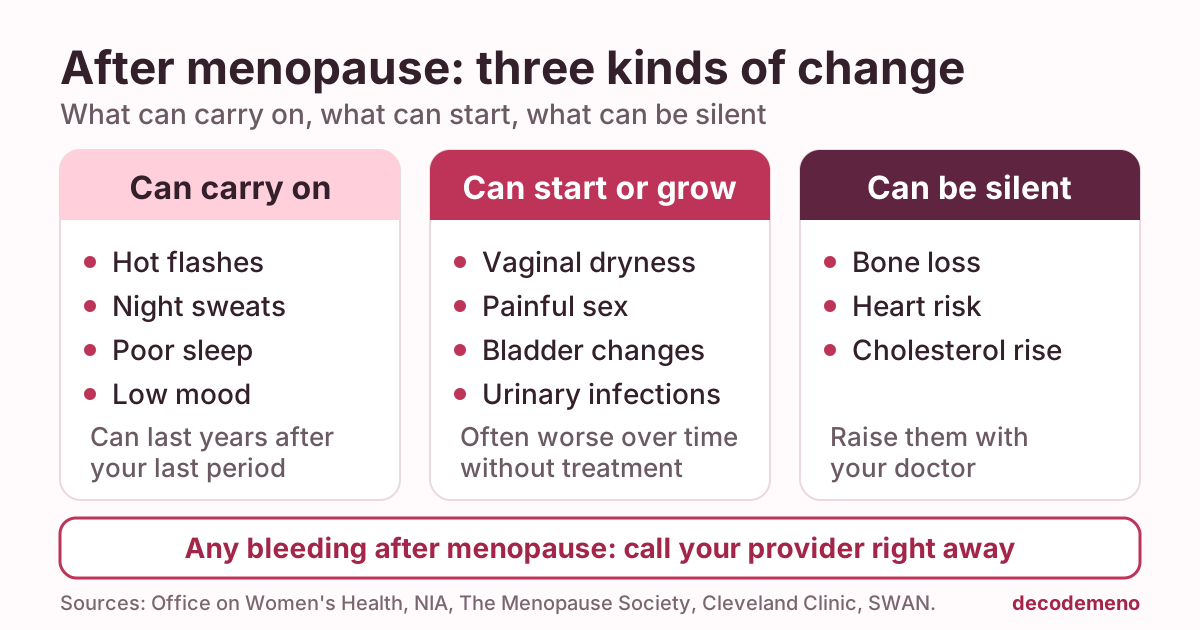
Postmenopause is every day after menopause, which is the day you reach 12 months in a row with no period or spotting. Hot flashes and night sweats can carry on for years. Vaginal dryness and bladder changes can start or grow. Bone and heart changes can be silent. Many symptoms ease over time, but vaginal and urinary ones often get worse without treatment.
Not sure which phase you're in? Our free perimenopause quiz gives an estimate in about five minutes.
In short
- Postmenopause starts the day after menopause and lasts the rest of your life.
- Hot flashes and night sweats can last for years. In a large US study, women who still had frequent hot flashes after their final period kept them a median of 4.5 more years (9.4 years if they began before or early in the transition).
- Vaginal dryness, painful sex and bladder problems can start or grow later, and often get worse without treatment, says The Menopause Society.
- Bone loss and heart changes can be silent. Osteoporosis can show no symptoms until a bone breaks, and some women with heart disease have none. Raise both with your doctor.
- Bleeding after menopause is not normal. Call your provider right away.
Any bleeding or spotting after menopause is not normal. See your provider right away, says the Office on Women's Health. The American College of Obstetricians and Gynecologists (ACOG) says it can be light pinkish-gray or brown spotting or a heavy flow. Cancer is the most serious cause, though the least likely, and only a careful evaluation can tell. For bleeding before menopause, see our guide to perimenopause periods.
What postmenopause means
In the US, the average age of menopause is 52. Our guide to perimenopause age shows when the transition starts. For the stages side by side, see perimenopause vs premenopause vs menopause.
Symptoms that can carry on
Hot flashes and night sweats. The Menopause Society says most menopause symptoms improve after menopause, even without treatment. The Office on Women's Health puts the average length at 7 to 12 years, and longer for some women.
The Study of Women's Health Across the Nation (SWAN) followed US women through the transition. For women with frequent hot flashes or night sweats (at least 6 days in 2 weeks), the median total was 7.4 years. The median is the middle value: half of women had them longer. Among 881 women who still had frequent ones after a dated final period, the median after it was 4.5 years. Women who first had them before or early in the transition kept them longer: a median of 9.4 years after it.
If hot flashes bother you, there are treatments, both hormonal and nonhormonal. Talk with your provider about their benefits and risks.
Sleep. A 2018 review reports sleep difficulties in 40% to 56% of women in the transition or after menopause, versus 31% of women in their late reproductive years. Night sweats, bladder symptoms and mood changes can all disrupt sleep. The National Institute on Aging (NIA) suggests a regular sleep schedule. See our guide to perimenopause sleep problems.
Mood and thinking. The Menopause Society says women appear particularly vulnerable to depression in the perimenopause years and the years right after menopause. Memory and focus changes often improve after menopause, says the Office on Women's Health, which adds that hormone changes can also affect hair, skin, joints, muscles and weight.
Symptoms that can start or grow later
Falling estrogen affects the tissue of the vagina, vulva, bladder and urinary tract. Doctors call this the genitourinary syndrome of menopause (GSM). The Office on Women's Health lists vaginal dryness, burning or itching, pain during sex, a sudden or frequent need to urinate, and repeat urinary tract infections (UTIs). The Menopause Society calls vaginal dryness and thinning the most common cause of painful sex at midlife and beyond.
For some women, GSM doesn't become a problem until several years after menopause. Unlike hot flashes, it often worsens over time without treatment. It can be treated, so tell your doctor. The Menopause Society also advises skipping soap, bath oil and bubble baths around the vaginal area.
Changes that can be silent
Bones. Bone loss speeds up after menopause. The Office on Women's Health says some women lose up to 25% of bone mass in the first 10 years after menopause. Osteoporosis, a disease of weak bones, is called "silent": you may lose bone for years with no symptoms until a bone breaks. A broken hip or spine bone can cost older adults their independence.
Heart and cholesterol. Cleveland Clinic says people after menopause face a higher risk of osteoporosis and heart disease. In SWAN, total cholesterol and LDL cholesterol (one type of cholesterol) rose substantially in the year before and the year after the final period. Heart disease is not always silent: chest pain or discomfort is its most common symptom. But some women with coronary artery disease (plaque buildup that narrows the arteries feeding the heart) have no symptoms at all. Ask your doctor what checks make sense for your bones and heart.
Everyday steps. The NIA advises a healthy diet, staying active, and enough calcium and vitamin D for bone health. The Office on Women's Health adds weight-bearing activity such as walking or dancing, and notes that women who smoke have lower bone density.
What to expect by time since your last period
Age is a rough guide. STRAW+10, the staging system doctors and researchers use, does not use age. It places you by time since your last period.
| Time since last period | What is more likely | Source |
|---|---|---|
| First 2 years | Hot flashes and night sweats are most likely, while hormone levels are still changing | STRAW+10, 2018 review |
| Next 3 to 6 years | Hormones level off, with estrogen staying low. Early postmenopause lasts about 5 to 8 years in all | STRAW+10 |
| After about 5 to 8 years | Vaginal dryness and genital and urinary changes grow more common. Hot flashes decline in many women, but not all | STRAW+10, 2018 review |
Postmenopause at 50 and at 60
At 50, you may not be postmenopausal yet. The Menopause Society says about half of women haven't reached menopause by 52, and about 90% have by 55. If you have gone 12 months in a row with no period and nothing else explains it (such as hormonal birth control, chemotherapy or radiation therapy), you are postmenopausal. Ask your provider if you are unsure. If you still have periods, see our guide to perimenopause symptoms.
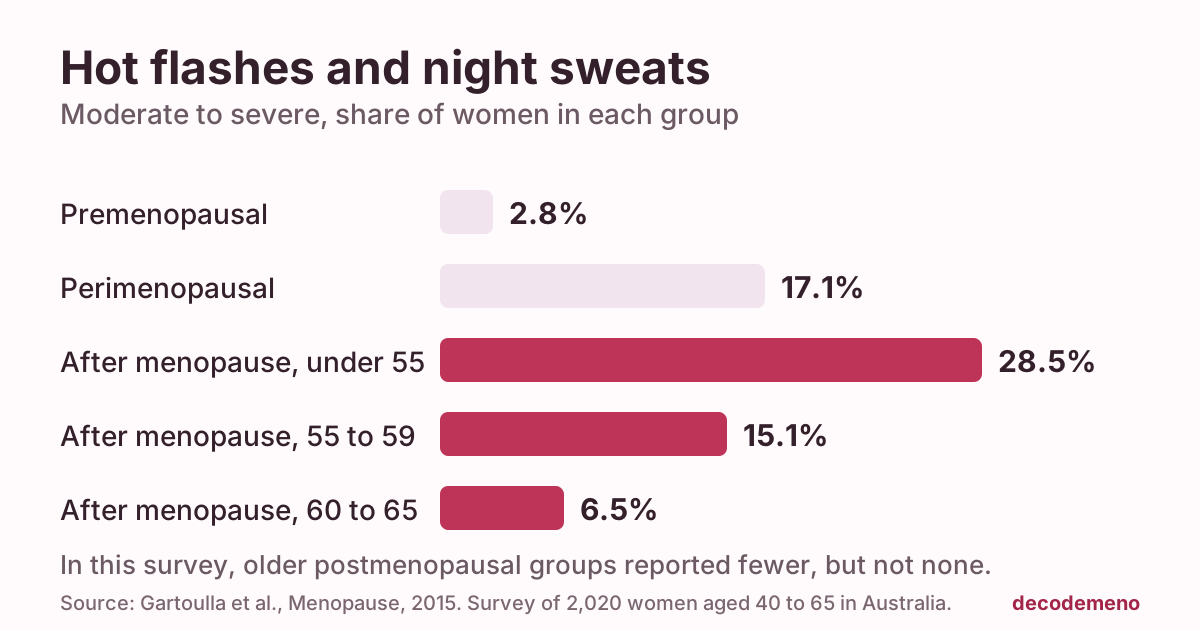
At 60, a woman who reached menopause at 52 is about 8 years past it. In a survey of 2,020 women aged 40 to 65 in Australia, moderate to severe hot flashes or night sweats affected 28.5% of postmenopausal women under 55 and 6.5% of those aged 60 to 65.
Want to see how your symptoms add up? Our free 5-minute quiz uses your age, your cycle and 21 common symptoms, scored on the Greene Climacteric Scale. It gives you an estimate of your phase, not a diagnosis. You see your result before we ask for your email, and you can skip that step. A detailed personal report is available for a fee if you want one. Take the free perimenopause quiz
When to see a doctor
- Any bleeding or spotting after menopause: right away.
- Pain with sex, burning, repeat UTIs or leaking: tell your provider.
- Mood changes. The NIA advises talking with your primary care provider or a mental health professional. In the US, if you are thinking about harming yourself, call or text 988 (the 988 Suicide & Crisis Lifeline). Help is available at any time.
- Chest pain or discomfort is the most common symptom of heart disease, says the Office on Women's Health. Heart attack symptoms: in the US, call 911 right away.
- Anything that bothers you. The NIA notes some midlife changes may be part of aging rather than menopause, and advises seeing your doctor every year.
The Office on Women's Health suggests bringing your symptoms, your health history (including cancer, blood clots and heart disease), any hormone therapy you have used, and how long it has been since your last period.
Frequently asked questions
Do hot flashes ever stop after menopause? Often they ease, but not always. The Menopause Society says most menopause symptoms improve after menopause, even without treatment. Some women have hot flashes for decades.
Can vaginal dryness or painful sex start years after menopause? Yes. For some women, GSM doesn't become a problem until several years after menopause.
Is spotting after menopause ever normal? No. Bleeding after menopause is not normal. Cancer is the most serious cause, though the least likely. See your provider right away.
Sources
- Office on Women's Health. Menopause basics, Menopause symptoms and relief, Osteoporosis and Heart disease and women. Accessed October 2026.
- National Institute on Aging. What Is Menopause?, Sleep Problems and Menopause and Osteoporosis. Accessed October 2026.
- The Menopause Society. Symptoms and Perimenopause. Accessed October 2026.
- American College of Obstetricians and Gynecologists. Bleeding After Menopause Could Be a Problem. Accessed October 2026.
- Cleveland Clinic. Menopause. Accessed October 2026.
- Harlow SD, et al. Executive summary of the Stages of Reproductive Aging Workshop + 10 (STRAW+10). 2012.
- Avis NE, et al. Duration of menopausal vasomotor symptoms over the menopause transition (SWAN). 2015.
- Matthews KA, et al. Are changes in cardiovascular disease risk factors in midlife women due to chronological aging or to the menopausal transition? (SWAN). 2009.
- Baker FC, et al. Sleep problems during the menopausal transition: prevalence, impact, and management challenges. 2018.
- Gartoulla P, et al. Moderate to severe vasomotor and sexual symptoms remain problematic for women aged 60 to 65 years. 2015.
This article is for education. It isn't medical advice and doesn't replace a visit with your doctor. Decodemeno sells a personal perimenopause report. Sources checked October 29, 2026.