
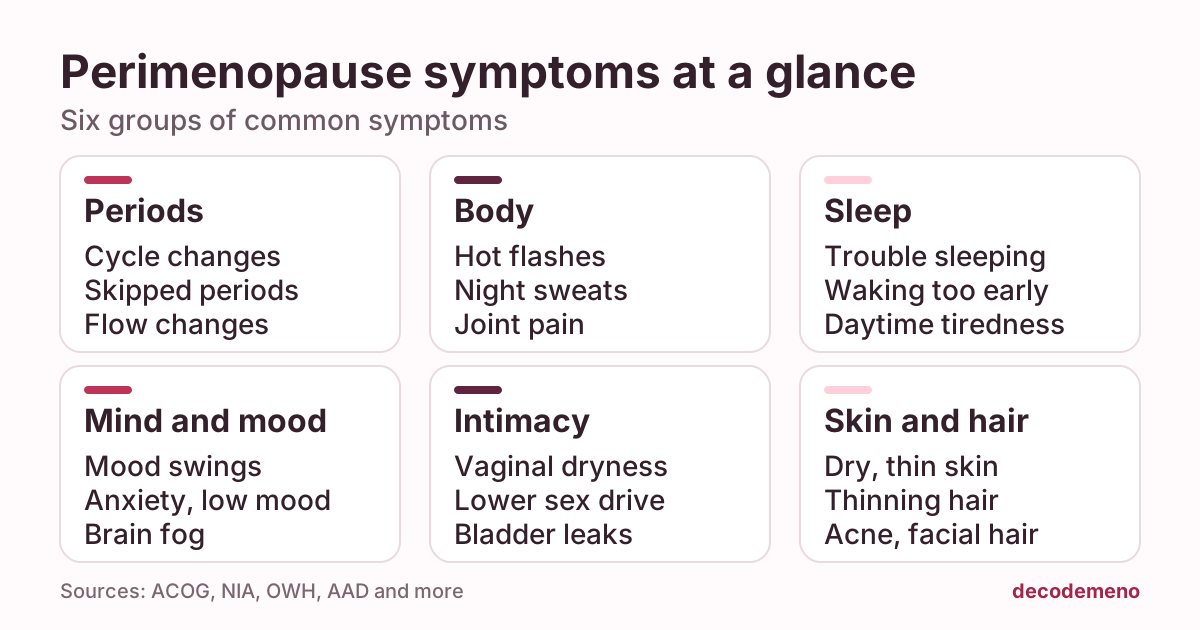
Common perimenopause symptoms include changes in your periods, hot flashes, night sweats, sleep problems, mood changes, vaginal dryness and a lower sex drive. Some women have no symptoms or only a few mild ones. Others have many, and they can be severe. This guide groups the symptoms by area of life and includes a checklist you can copy and bring to your doctor.
Want to see how your own symptoms add up? Our free perimenopause quiz takes five minutes.
In short
- Symptoms differ a lot from one woman to the next. The American College of Obstetricians and Gynecologists (ACOG) says some women have no symptoms or only a few mild ones, and others have many that can be severe.
- Irregular periods are generally the first sign, according to Cleveland Clinic. Cycles can get shorter or longer, the flow can get lighter or heavier, and you may skip periods.
- Hot flashes and night sweats are the most commonly reported symptoms of the menopause transition (another name for perimenopause), according to The Menopause Society.
- Some symptoms resemble those of other conditions. Cleveland Clinic advises talking to your health care provider about what you're experiencing, because they can confirm the cause.
- Some bleeding needs a medical visit. Heavy bleeding, periods very close together, and any bleeding after 12 months with no period are reasons to see a doctor.
The most common perimenopause symptoms
Perimenopause is the time before menopause when your hormone levels change, says the Office on Women's Health (OWH). Those hormones act in nearly every system of your body. That is why symptoms can show up in so many places.
Your periods
A change in your cycle is a common sign of perimenopause, says ACOG.
- Shorter or longer cycles. The time between periods can get shorter or longer than usual for you.
- Skipped periods. You may skip a period now and then.
- Lighter or heavier flow. The amount of bleeding can change, and so can the number of bleeding days.
- Worse PMS. Some people notice that premenstrual symptoms get worse, says Cleveland Clinic.
These changes are normal in perimenopause. ACOG still says to report them to your doctor, because abnormal bleeding may be a sign of a problem.
Your body
Up to 80% of women have hot flashes or night sweats at some point during the menopause transition. That comes from one large US study, says The Menopause Society.
- Hot flashes. A sudden feeling of heat, most often in the upper body and face. They often last between 30 seconds and 10 minutes, says the National Institute on Aging (NIA).
- Night sweats. Hot flashes that happen during sleep.
- A racing heart or chills. Some women feel a rapid heartbeat, or have chills, during a hot flash.
- Joint and muscle aches. In a review of 37 studies, 57% of women in perimenopause had muscle or joint pain, compared with 40% of women before perimenopause. See our guide to joint pain and frozen shoulder in perimenopause.
- Headaches. The Menopause Society says shifting estrogen levels may cause hormone headaches to increase.
- A bigger waist. The NIA says your waist could get larger, and you could lose muscle and gain fat. See our guide to perimenopause weight gain.
Sleep
Night sweats, bladder symptoms and mood changes can disrupt your sleep, says OWH.
- Trouble falling asleep. ACOG calls this insomnia.
- Waking too early. You may wake up long before your usual time.
- Waking in the night. Night sweats or a need to urinate may wake you, and it may then be hard to fall back asleep, says the NIA.
- Feeling tired the next day. ACOG says night sweats may wake you and leave you tired and sluggish during the day.
- More help. See our guides to perimenopause sleep problems and perimenopause fatigue.
Mind and mood
Hormone changes can affect your emotions, says ACOG. Physical symptoms can add stress and tiredness.
- Irritability and mood swings. You may feel moodier or more irritable. See our guide to irritability, rage and mood swings in perimenopause.
- PMS-like mood changes. About 4 in 10 women have mood symptoms like PMS during perimenopause. Unlike PMS, they may come at times unrelated to your cycle.
- Anxiety. Constant worry that gets in the way of your day. Few studies look at anxiety in perimenopause, but some women report it.
- Low mood or depression. Most studies agree that the risk of depression goes up during the menopause transition. Signs include crying a lot, feeling hopeless or worthless, feeling numb, and losing interest in your usual activities.
- Brain fog. Trouble finding words or focusing. It is common in perimenopause and often improves after menopause, says OWH. The Menopause Society says the changes are typically mild and that dementia at midlife is very rare. If memory changes worry you, tell your doctor. Our guide explains what brain fog feels like and when to get it checked.
- Not feeling like yourself. OWH lists this as a symptom of its own.
Intimacy and bladder
The Menopause Society says many women do not notice vaginal and bladder changes in perimenopause. For some, they become a problem only years after menopause.
- Vaginal dryness. The lining of the vagina may become thinner, drier and less elastic, says ACOG.
- Pain during sex. Vaginal dryness and thinning are the most common cause of painful sex at midlife and beyond, says The Menopause Society.
- Burning, itching or irritation of the vagina and vulva, says OWH.
- A change in sex drive. Your interest in sex can change, and it might be lower.
- Bladder changes. A sudden urge to urinate, or leaks when you exercise, sneeze or laugh.
- More urinary tract infections (UTIs). Lower estrogen can raise the risk of UTIs, says ACOG.
Skin and hair
OWH says falling hormones can affect your hair and skin.
- Dry, thin skin. The American Academy of Dermatology (AAD) says skin can become dry, slack and thin at menopause, and thin skin bruises more easily.
- Thinning hair on your head. The first sign may be a widening part, says the AAD. See our guide to perimenopause hair loss.
- More hair on your face. Hair can appear under your chin, along your jawline or above your lip.
- Acne. As female hormone levels drop before and during menopause, some women develop teenage-like acne.
Other changes to know about
MedlinePlus says falling estrogen can also lower bone density and raise cholesterol. ACOG advises a yearly visit with your doctor for regular exams and tests, even if you are not sick.
Early signs of perimenopause, and what tends to come later
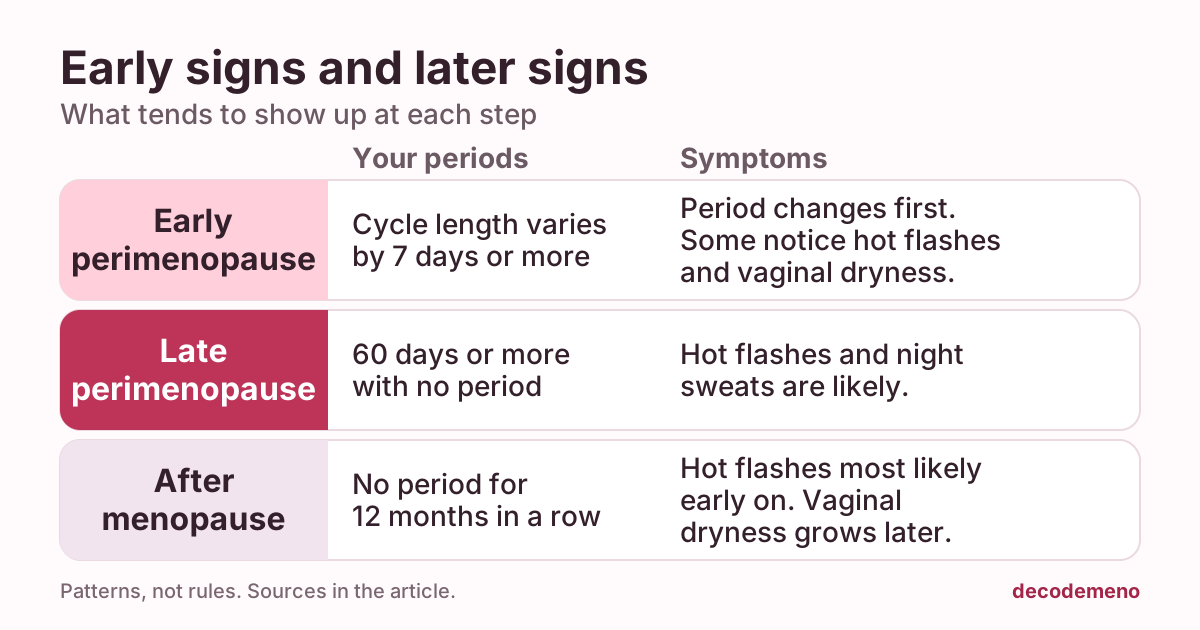
STRAW+10 is a staging system for the years around menopause. Your periods are its most important guide. Symptoms are extra information, because they are subjective and not everyone has them.
| Step | Your periods | Symptoms that tend to show up |
|---|---|---|
| Early perimenopause | At first the changes are often subtle: cycles a little shorter, flow lighter or heavier. Then cycle length varies by 7 days or more | Period changes often come first. Some people also notice hot flashes and vaginal dryness early on |
| Late perimenopause | You may go 60 days or more without a period | Hot flashes and night sweats are likely |
| After menopause | No period for 12 months in a row | Hot flashes are most likely in the first years. Vaginal dryness becomes more common over time |
- How long. Perimenopause lasts about four years on average, but it can last up to eight, says Cleveland Clinic.
- Patterns, not rules. Timing and symptoms are highly variable among women, says the NIA.
- Birth control can hide the signs. The Menopause Society says hormone contraceptives can mask the signs of menopause.
- Ages and timing. See our guide to perimenopause age and stages.
Perimenopause symptoms checklist
Copy or screenshot this list and bring it to your appointment. Check each box that fits. For each one, write down when it started, how often it happens, and whether it is mild, moderate or severe. OWH asks you to bring your symptoms and how much they bother you.
Your periods
- Cycles shorter or longer than usual
- Skipped periods
- Lighter or heavier flow
- PMS that feels worse
Your body
- Hot flashes
- Night sweats
- Racing heart or chills during a hot flash
- Joint or muscle aches
- Headaches
- Bigger waist
Sleep
- Trouble falling asleep
- Waking too early
- Waking in the night
- Tired during the day
Mind and mood
- Irritable or moody
- Anxious or constantly worried
- Low mood or feeling hopeless
- Forgetful or hard to focus
- Not feeling like myself
Intimacy and bladder
- Vaginal dryness
- Pain during sex
- Lower interest in sex
- Burning, itching or irritation
- Sudden urge to urinate, or leaks
- Repeat urinary tract infections
Skin and hair
- Dry or thin skin
- Bruising more easily
- Thinning hair on my head
- More hair on my face
- Acne
Also bring to your visit, as OWH advises:
- My health history, including cancer, blood clots and heart disease
- Any hormone therapy I have used
- How long it has been since my last period, and a journal of my cycles (Cleveland Clinic)
Questions to ask your doctor, from Cleveland Clinic:
- Are these symptoms of perimenopause?
- What can I do to relieve my symptoms?
- How long do you think I will have these symptoms?
- Would hormone therapy be an option for me?
- Are there any tests that should be done?
- When should I call my provider?
Want to see how your symptoms add up? Our free 5-minute quiz uses your age, your cycle and 21 common symptoms, scored on the Greene Climacteric Scale. It gives you an estimate of your phase, not a diagnosis. You see your result before we ask for your email, and you can skip that step. A detailed personal report is available for a fee if you want one. Take the free perimenopause quiz
Is it perimenopause or something else?
Some midlife changes may be part of aging, not menopause itself, says the NIA. Cleveland Clinic says some perimenopause symptoms resemble those of other conditions.
| If you notice | It can also be |
|---|---|
| Heavy, long or irregular bleeding | Several other causes. Cleveland Clinic and The Menopause Society name infections, thyroid problems, some medicines or herbal products, and cancer, among others |
| A missed period | Pregnancy. OWH says you can get pregnant during perimenopause, even if you skip periods |
| Low mood or constant worry | Stress, family demands, depression or extra tiredness, says the NIA. Your ob-gyn (a doctor for women's reproductive health) can help work out if a mental health condition is involved, says ACOG |
| Tiredness, weight gain, dry skin, thinning hair, aching joints, heavy or irregular periods | An underactive thyroid, says the National Institute of Diabetes and Digestive and Kidney Diseases (NIDDK). Tiredness and weight gain are common and do not necessarily mean a thyroid problem. A blood test might confirm it |
| Thinning hair | Many things can cause hair loss, says AAD. It advises seeing a board-certified dermatologist, a medical doctor for skin, hair and nails, at the first sign of a problem |
When to see a doctor
Period changes are normal in perimenopause, but ACOG says to report them.
See a doctor if:
- your periods come very close together (Cleveland Clinic says less than 21 days apart)
- your bleeding is heavy, you pass large clots, or you change a pad or tampon every one to two hours
- your periods last more than a week
- you bleed or spot between periods or after sex
- you bleed or spot again after 12 months with no period (OWH says to see a provider right away)
- your symptoms are unbearable or get in the way of your quality of life
- you have new or worsening pain, or trouble sleeping (OWH says to tell your provider)
- your periods stop before age 40 (OWH's menopause basics page says you can ask about testing)
For your mood: If you are thinking about harming yourself, call or text 988 to reach the 988 Suicide & Crisis Lifeline. Help is available at any time, says OWH. The NIA also advises talking with a primary care provider or a mental health professional about mood changes. In a medical emergency, call 911 or go to the nearest emergency room.
Treatment is your choice. The NIA says many women find they do not need treatment. If you want treatment, options may include lifestyle changes, nonhormonal medicines and hormones. Ask your doctor what fits your symptoms, health history and preferences.
Frequently asked questions
What are the first signs of perimenopause? Usually a change in your periods, says Cleveland Clinic. Cycles can get shorter or longer, the flow can get lighter or heavier, or you may skip a period. Some people also notice hot flashes and vaginal dryness early on.
Do I need to have every symptom on the list? No. ACOG says some women have no symptoms or only a few mild ones. The Menopause Society says many women who go through natural menopause report no physical changes except irregular periods. STRAW+10 relies mainly on your periods, not on a symptom count.
Are menopause symptoms the same as perimenopause symptoms? Largely, yes, because menopause symptoms can begin in perimenopause, says OWH. The difference is your periods: menopause is confirmed only after a full year without one, says the NIA. The Menopause Society says most symptoms improve after menopause, even without treatment, but vaginal and urinary symptoms often get worse without treatment.
Can perimenopause cause itchy skin or a rash? Possibly. The AAD lists rashes and easily irritated skin among the skin changes of menopause. OWH also lists itching and irritation of the vagina and vulva. The AAD advises seeing a dermatologist if a rash lasts or a skin condition gets worse.
Do I need a blood test to know if it's perimenopause? Usually not, says OWH. Cleveland Clinic explains that hormone levels rise and fall so much that an FSH (follicle-stimulating hormone) test can be misleading. The NIA says a doctor may suggest a blood test in some cases, for example if your periods stopped at an early age.
More in our menopause and perimenopause guides.
Sources
- American College of Obstetricians and Gynecologists. The Menopause Years. Accessed October 2026.
- American College of Obstetricians and Gynecologists. Mood Changes During Perimenopause Are Real. Here's What to Know. Accessed October 2026.
- National Institute on Aging. What Is Menopause? Accessed October 2026.
- Office on Women's Health. Menopause symptoms and relief. Accessed October 2026.
- Office on Women's Health. Menopause basics. Accessed October 2026.
- The Menopause Society. Perimenopause. Accessed October 2026.
- The Menopause Society. Symptoms. Accessed October 2026.
- Cleveland Clinic. Perimenopause. Accessed October 2026.
- Harlow SD, et al. Executive summary of the Stages of Reproductive Aging Workshop + 10 (STRAW+10). 2012.
- American Academy of Dermatology. Caring for your skin in menopause. Accessed October 2026.
- National Institute of Diabetes and Digestive and Kidney Diseases. Hypothyroidism (Underactive Thyroid). Accessed October 2026.
- MedlinePlus, National Library of Medicine. Menopause. Accessed October 2026.
This article is for education. It isn't medical advice and doesn't replace a visit with your doctor. Decodemeno sells a personal perimenopause report. Sources checked October 28, 2026.